Net Promoter Score (NPS) 101

What is Net Promoter Score (NPS)?
Net Promoter Score or ‘NPS’ is a simple method of measuring the overall likelihood of a customer recommending your product, service, or company to a friend or colleague. NPS scores are an indicator of how much you have delighted a customer will bring another customer to your business, helping you grow your customer base and revenue.
Think of it this way. You’ve just had a great experience with a vendor—maybe they solved a complex problem quickly, or they made your team’s workflow significantly easier. Later that week, a colleague mentions they’re struggling with the same challenge. Would you recommend that vendor?
That’s the essence of what NPS measures: the strength of customer relationships through the lens of advocacy.
Why use NPS®?

Linked to Profit
According to Bain & Company, the developers of the Net Promoter Score, “Companies that achieve long-term profitable growth – have NPS scores two times higher than the average company.” And this makes perfect sense. If you increase delight in your customer base then they are less likely to churn.

The measure of Consumer Behaviour
The Net Promoter Score is a simple yet practical way to measure the attitudes and behaviours of customers. Net Promoter® surveys can consist of just two to three questions which can easily be done via a number of means.

Simple to
Understand
Net Promoter Score calculation does not include complex statistical analogy but a single number that can be measured weekly or monthly. Bain & Co discovered through their extensive research that Net Promoter Score explained roughly 20% to 60% of the variation in organic growth rates among competitors.
What Makes NPS Different from Other Metrics?
You might be wondering: “We already track customer satisfaction (CSAT) and other metrics—why add NPS?”
Here’s the key difference between CSAT and NPS: NPS is a loyalty metric, not just a satisfaction metric. CSAT measures satisfaction with specific interactions, while NPS measures the strength of the overall customer relationship and predicts future behavior like retention and referrals.
In short: NPS is a leading indicator of business growth, while most other metrics are indicators of past performance.
How to calculate NPS
Once you have successfully launched your CX Program, The Net Promoter Score is calculated by the percentage of who are promoters subtracted from the percentage of detractors.
NPS = % Promoters – % Detractors
Doing this allows companies to measure the overall performance through their customers’ eyes. High scores on this question correlated strongly with repurchases, referrals, and other factors that contribute to a company’s growth.
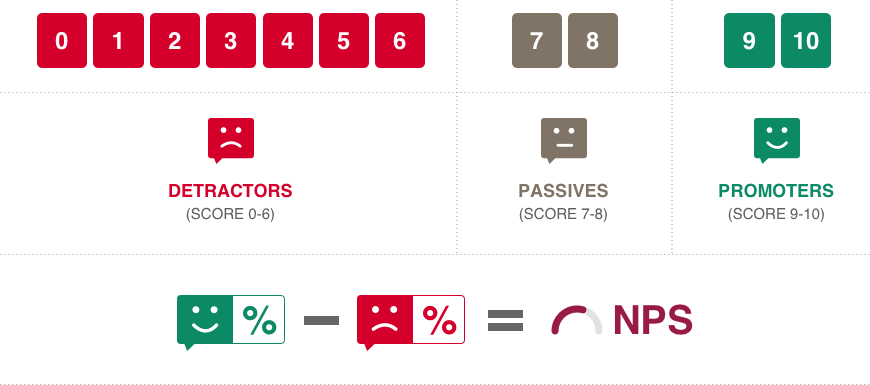
For example, if 25% of your respondents are Detractors (scored 0-6), 27% are Passives (scored 7-8) and 48% are Promoters (scored 9-10), your Net Promoter Score is 48-25 = 23.
Measuring Net Promoter Score
To measure NPS, customers are asked the ultimate question:
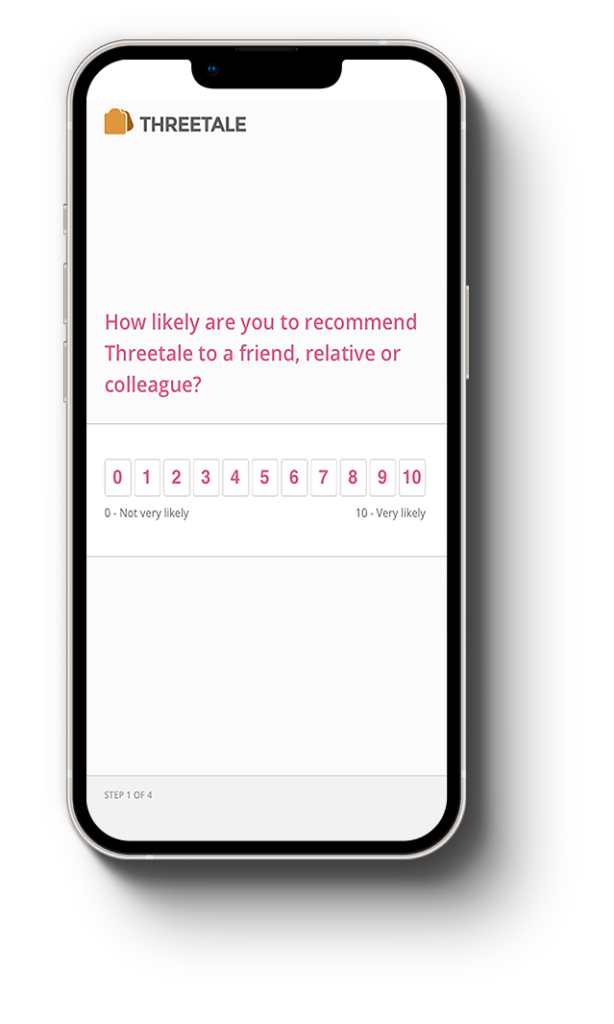
How likely is it that you would recommend Company-X to a friend or colleague?
The answer is measured on a scale from 0 to 10. Then segment results into three categories: Promoters, Passives, and Detractors.
Promoters: those who score 9-10 are more loyal customers who are likely to buy more and help grow the business
Passives: those who score 7-8 are satisfied with your product or service but are still more vulnerable to competitive offerings
Detractors: those who score 0-6 are unhappy with your company and are highly likely to churn or spread negative words about your business
Types of NPS
Measuring what matters
Not all NPS surveys are created equal. Depending on what you want to measure, you’ll use different types of NPS surveys at different points in the customer journey:

Relationship NPS
Measures the customer’s overall, long-term sentiment toward your company and how they feel about their relationship with your brand over time.

Episodic NPS
Measures how a customer feels right after a specific episode or journey, such as onboarding, a claim, or a service visit. It captures loyalty drivers within that end-to-end experience, not just a single touchpoint.

Transactional / Touchpoint NPS
The difference between transactional and relational surveys is that the former measures sentiment after a single interaction, like a support call, delivery, or checkout. It helps teams improve individual touchpoints that collectively shape the broader customer journey.
How The Net Promoter System® Became the Gold Standard
The Net Promoter System is a company-wide, top-down framework that aligns leadership, employees, processes, and strategy around delivering better customer outcomes.
As Bain & Company explains, it begins with senior leaders who set a clear, customer-focused vision and use Net Promoter Score as the central metric to track progress. The system also includes asking an open-ended question to understand the reason behind each score.
From there, the feedback flows into two improvement engines: the Inner Loop and Outer Loop, with the Inner Loop fixing issues for individual customers and the Outer Loop addressing broader, systemic improvements.
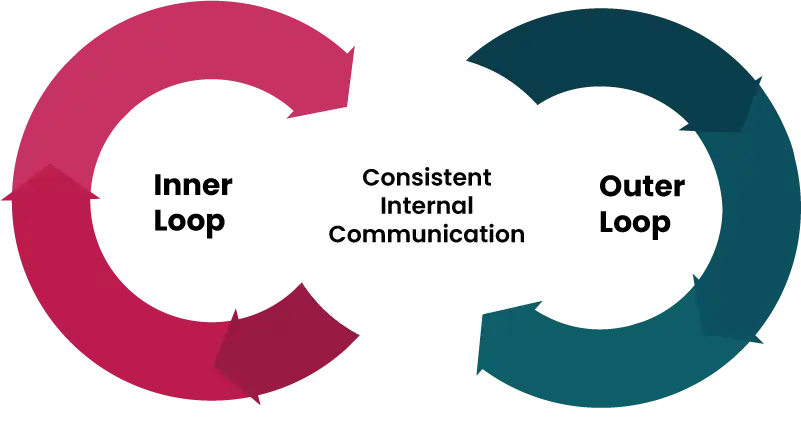
Inner Loop = Fix it for this customer, right now
The inner loop is all about quick, tactical recovery.
When a customer gives negative feedback, the frontline or the owning team jumps in to close the loop:
- Call the customer back
- Apologise or clarify
- Solve the issue
- Recover the relationship
It’s focused on individual cases, fast action, and preventing churn.
Inner loop = “Let’s fix what went wrong today.”
Outer Loop = Fix it for all customers, long-term
The Outer Loop is used when the actions needed go beyond what frontline teams can resolve. It is where you step back and look at patterns. You’re no longer solving one complaint. You’re solving the root cause behind many.
This is usually led by CX, Ops, or cross-functional teams and involves:
- Finding recurring issues across feedback
- Looking at systemic problems
- Updating processes, policies, pricing, communication
- Improving products or service design
Outer loop = “Let’s fix what keeps going wrong.”
The Inner Loop
After the NPS question, customers are asked an open-ended “why?” to explain their rating. This feedback includes both the score and the customer’s comments, which are then routed to the teams directly involved so they can take action and close the loop.
The Inner Loop gives frontline teams the opportunity to learn from the feedback, make improvements quickly, and involve supervisors only when additional support or escalation is needed.
The Outer Loop
The Outer Loop is used when the actions needed go beyond what frontline teams can resolve. It requires digging into the root causes of issues and examining the processes, policies, and systems that created them. This involves combining Inner Loop feedback with operational data, frontline insights, and market intelligence to understand what’s affecting customer experience, see the impact of an NPS program and to prioritise broader improvements.
Between these steps, it’s essential to maintain open communication between frontline teams and head office. Weekly discussions help build commitment, create channels for support, and provide a clear path for escalating serious issues. Using customers’ verbatim feedback through a Voice of Customer Platform also helps teams understand sentiment and use it to guide decisions.
Employees must stay engaged by recognising that their frontline actions directly shape customer experience. When hiring, look for candidates with strong Emotional Quotient (EQ), not just IQ. Provide continuous training, introduce new concepts regularly, and maintain strong rewards and recognition programmes to keep motivation high and prevent dilution over time.
The Net Promoter System in Action
With the data and information at hand, you can now start optimising your CX Program. Here’s what it looks like when fully implemented:
- Customer gives feedback → Score and comments captured
- Inner Loop activates → Individual follow-up within 24-48 hours
- Outer Loop analyses → Patterns identified for systemic fixes
- Cross-functional teams → Work together on iterations on how to improve NPS.
- Leadership reviews → Progress tracked, resources allocated
- Repeat continuously → Ongoing cycle of listening and improving
This system transforms NPS from a metric you track into a management philosophy that permeates your entire organisation, to a breakthrough CX program that helps drive business growth.
Start Your NPS Program with Resonate CX
Take your CX Program to the next level with Resonate CX.
Throughout your CX program and phases, from survey deployment to closing the loop with customers, Resonate CX NPS Platform gives you a complete Net Promoter System in one platform to measure NPS accurately, diagnose what drives your score, and take action.
Need to start measuring NPS?
See how the Resonate CX Platform enables the inner and outer loop and delivers the complete Net Promoter System.
Related Resources
Guides and eBooks

Introduction to Launching Successful CX Programs
Learn how NPS works and understand closed-loop feedback to elevate your CX strategy.
Blog

Different Types Of NPS – Why And When To Use Them
All of us have, at some point, received a text or email survey from our favorite service provider asking “How likely are you to to recommend us to a friend or colleague?”.
Reports and Whitepapers

Integrating NPS with Data Strategy
Discover how integrating NPS into data strategies can optimize marketing, enhance customer insights, and drive business growth.
