TLDR:
- CX platform migration from GetFeedback fails for organisational reasons, not technical ones: missing data exports, broken survey continuity, and unstated integration dependencies are the top three causes. Fix these before you sign a new contract.
- The best NPS software and experience management platforms go live in weeks, not months: Resonate CX’s structured onboarding targets first surveys live within two weeks, with full cutover in four to six weeks using a no-disruption parallel running approach.
- What separates the best NPS survey tools from the rest is not survey functionality: it is closed-loop workflows, AI text analytics, real-time frontline dashboards, and multi-channel deployment that determine whether your new platform actually gets used.
- A phased migration (audit, configure, parallel run, cutover, optimise) eliminates data risk: running both platforms simultaneously for two to four weeks before cutting over ensures score continuity, benchmark preservation, and stakeholder confidence from day one.
- TasNetworks migrated from a decade-old system to Resonate CX with zero reporting gap, going from 140 to over 5,000 monthly survey responses and replacing a 2–3 month insight lag with real-time dashboards, proof that the right implementation partner makes all the difference.
Why CX Leaders Are Replacing GetFeedback Right Now
The decision to replace GetFeedback rarely arrives suddenly. It builds. Reporting is slow. Dashboards sit unused. Frontline teams never log in. The NPS score arrives monthly and nobody acts on it.
CX platform migration is now one of the fastest-growing operational priorities for CX leaders. According to Gartner, while 75% of organisations have increased investment in CX technology, implementation failure rates remain high, and the most common cause is not the platform itself but the gap between data collection and action. When your current tool collects data that nobody acts on, you are not running a CX programme. You are running a reporting cycle.
The specific frustrations driving CX teams away from GetFeedback typically cluster around four themes:
Slow time to insight. Teams wait days or weeks for reports. By the time the data reaches decision-makers, the customer moment has passed.
No closed-loop workflows. The tool captures the score but has no native mechanism to alert the right person, trigger a recovery call, or route feedback to the frontline team that can fix it.
Poor frontline adoption. The platform is used by the CX team and ignored by everyone else. Managers don’t log in. Frontline staff never see the data. The programme exists in a silo.
Limited AI capability. Open-text verbatims pile up unread. There is no automated theme detection, no trending topics dashboard, no way to process thousands of comments without manual effort.
If any of these resonate, you are already in the decision phase. The next question
Customer Experience Case Studies
Real Brands. Measurable Results.
Discover how leading brands improved customer experiences, drove measurable growth, and turned feedback into actionable results.
Real organisations. Real outcomes. Act in real time.
What the Best NPS Software Must Deliver That GetFeedback Doesn’t
Before choosing your replacement platform, it helps to be explicit about what you are actually buying. The best NPS software is not distinguished by survey functionality, every platform can send an NPS question. It is distinguished by what happens after the survey response comes in.
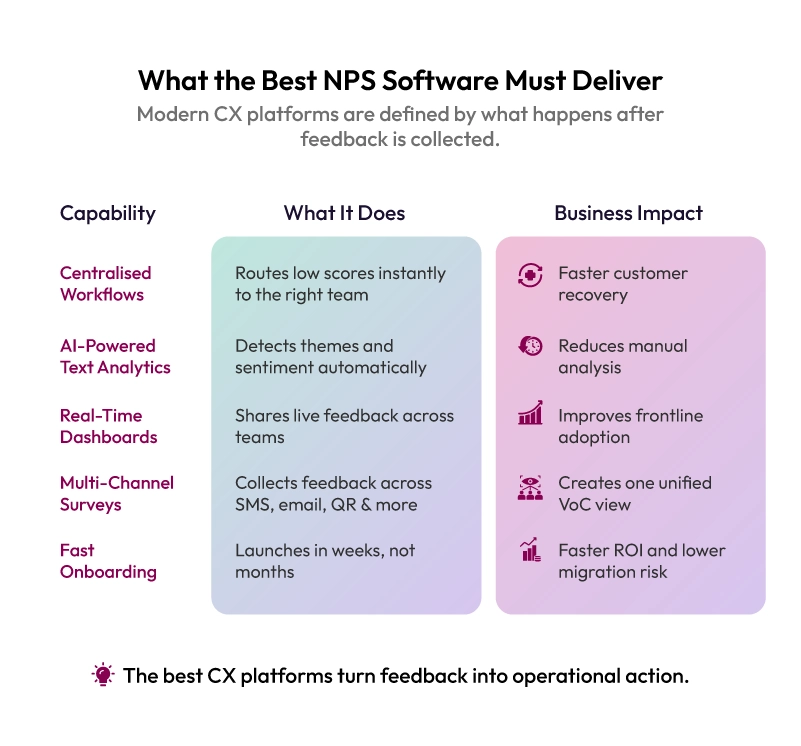
Here is the framework for evaluating customer experience management software when you are actively replacing GetFeedback:
Closed-Loop Feedback Workflows
The single most important capability in any experience management software is the ability to automatically route a low-score response to the right person within hours, not days. Closed-loop feedback is the mechanism that turns a score into a recovered relationship. If the platform cannot do this natively, it is a data collection tool, not a CX management platform.
AI-Powered Text Analytics
The volume of open-text responses in any serious NPS programme makes manual review impractical. AI text analytics automatically categorise verbatims into themes, surface trending topics, and flag emerging issues before they appear in the score. This is now a standard requirement for experience management and insights platforms, not an optional add-on.
Real-Time Frontline Visibility
The best NPS tools make customer feedback visible to every person who can act on it, not just the CX team. Live dashboards, mobile apps, and shared screen displays (like Resonate CX’s Customer Centre Stage) are what drive the cultural shift from “CX is the customer team’s job” to “CX is everyone’s job.”
Multi-Channel Survey Deployment
Modern voice of customer software deploys feedback collection via SMS, email, QR code, kiosk, in-app, and post-call IVR from a single platform. If your new tool requires different systems for different channels, you have recreated the data silo problem in a different form.
Go-Live Speed
This is underweighted in most buying decisions and overweighted in actual migrations. A platform that takes four months to implement means four months with no improvement in your CX programme. The realistic CX implementation timeline for best-in-class platforms is two weeks to first surveys, not two months.
Industry Benchmarking
A score without context is noise. The best NPS survey tools include benchmarking capability that lets you compare your scores against industry peers. Knowing that your NPS is 42 means little without knowing whether the retail average is 35 or 55.
For a comprehensive evaluation framework, the NPS software buyer’s checklist covers 47 specific questions to ask any vendor before signing.
Before You Start Your CX Platform Migration: 5 Non-Negotiable Steps
These five steps should be completed before you sign the new contract, not during the migration, and certainly not after.
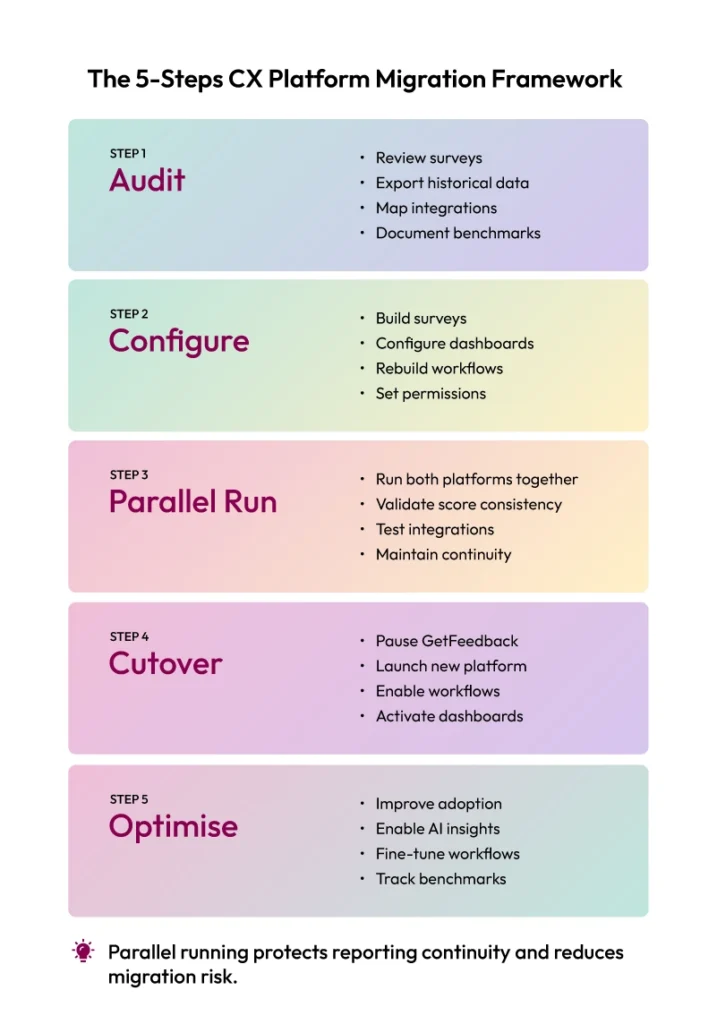
Step 1: Audit Your Current VoC Programme
Document every active survey in GetFeedback: what it measures, who receives it, what triggers it, and what response rate it achieves. Note which surveys feed regulatory reporting, executive dashboards, or real-time operations, these are your highest-priority continuity items.
Also document your current NPS benchmarks, CSAT baselines, and trend data. These numbers become the continuity bridge that confirms your new programme is producing equivalent data after go-live.
Step 2: Export Everything Before You Cancel
GetFeedback allows data exports, but the window closes permanently when you cancel your subscription. Export now:
- All historical survey responses (CSV format)
- Verbatim comment archives
- Segment-level reports and benchmark snapshots
- User accounts and permission structures
- Custom dashboard configurations worth replicating
Store these in a shared drive accessible to both your CX team and your new implementation partner. Do not rely on GetFeedback to retain this data after your contract ends.
Step 3: Map Every Integration Dependency
List every system GetFeedback connects to: your CRM (Salesforce is the most common), your IVR, your operational data platform, any BI tools pulling survey data. For each integration, note the connection method (API, native connector, Zapier, manual export) and who owns it technically.
This map tells your new vendor exactly what needs to be rebuilt and in what order. Choosing customer experience management software that natively supports your existing stack avoids the integration rebuild becoming a six-week project blocker.
Step 4: Design Your Survey Continuity Bridge
A survey continuity bridge is the plan that ensures feedback collection never stops during migration. It typically means:
- Identifying your highest-priority surveys (regulatory reporting, leadership dashboards, real-time operational alerts)
- Running your new platform surveys in parallel with GetFeedback for two to four weeks before cutover
- Confirming score distributions and response rates are consistent across both platforms before committing to the switch
Parallel running adds two to four weeks to your timeline but eliminates the risk of a reporting gap that permanently undermines stakeholder trust in the new programme.
Step 5: Secure Stakeholder Alignment Before You Announce the Switch
According to Harvard Business Review, the hardest part of any technology change programme is not the technology, it is the people. A CX platform migration affects operations, IT, frontline managers, and executive dashboards. Each group has legitimate concerns that need to be answered before the switch, not during it.
Brief stakeholders on what will change, what will stay the same, and what they will gain. Frame it around outcomes: faster insights, real-time alerts, less manual reporting work. Teams that understand the rationale before migration starts are significantly more likely to adopt the new platform after go-live. Understanding why CX implementations fail is essential preparation before any platform switch.
How to Choose the Best Experience Management Software When You’re Ready to Switch
This is a decision that most CX leaders underinvest time in. They evaluate demos, compare feature lists, and choose the platform that looks most similar to what they already have. That is a trap.
The goal is not to find a platform that replicates GetFeedback. It is to find a customer experience management software that solves the problems GetFeedback never could. The three solution categories every replacement should cover:
NPS and Relationship Measurement. Your replacement needs robust NPS Programme management, including transactional NPS, relationship NPS, industry benchmarking, and driver analysis that tells you not just the score, but what is moving it. Look for platforms where NPS is a strategic tool, not a data point.
Voice of Customer Programme. The best voice of customer software enables a complete VOC Programee, capturing feedback across every channel, processing it with AI, routing it to the right people, and closing the loop automatically. If the platform treats VoC as survey sending, it is not a VoC platform.
Customer Experience Management Platform. The broadest and most important category: a CX management platform that integrates measurement, analytics, action, and benchmarking into a single system. This is what separates experience management and insights platforms from survey tools. The right platform does not just tell you what customers think, it tells you what to do about it, and makes sure the right person does it.
According to Salesforce’s State of the Connected Customer research, 88% of customers say the experience a company provides matters as much as its products or services, yet most organisations still run disconnected feedback systems that cannot deliver on this expectation. That is the gap a proper experience management software migration is designed to close. Your replacement needs robust NPS programme management, including transactional NPS, relationship NPS, industry benchmarking, and driver analysis that tells you not just the score but what is moving it. Look for platforms where NPS is a strategic tool, not a data point.
Voice of Customer Programme. The best voice of customer software enables a complete VoC programme, capturing feedback across every channel, processing it with AI, routing it to the right people, and closing the loop automatically. If the platform treats VoC as survey sending, it is not a VoC platform.
Customer Experience Management Platform. The broadest and most important category: a CX management platform that integrates measurement, analytics, action, and benchmarking into a single system. This is what separates experience management and insights platforms from survey tools. The right platform does not just tell you what customers think, it tells you what to do about it, and makes sure the right person does it.
According to Salesforce’s State of the Connected Customer research, 88% of customers say the experience a company provides matters as much as its products or services, yet most organisations still run disconnected feedback systems that cannot deliver on this expectation. That is the gap a proper experience management software migration is designed to close.
What a Real CX Platform Migration Looks Like: TasNetworks
When TasNetworks, Tasmania’s electricity network operator, decided to modernise their VoC programme, the stakes were unusually high. As a regulated utility, their customer feedback data fed regulatory submissions. Any gap in reporting continuity would have had compliance implications, not just CX ones.
Their existing system had been in place for ten years. Survey responses arrived 4–6 weeks after the customer interaction. Reports took another four weeks to compile. The total lag between customer experience and management insight was two to three months. With only 140 monthly survey completions representing less than 1% of interactions, TasNetworks lacked the statistical confidence to make decisions from the data.
Working with Resonate CX’s implementation team, TasNetworks co-designed a migration that maintained full reporting continuity throughout:
- Shorter, smarter surveys (redundant questions removed using operational data)
- Real-time dashboards replacing static PowerPoint reports
- Automated insight distribution to regional teams
- Secure, automated data flows replacing manual export processes
- Executive mobile app access for live performance monitoring
The results after migration were reported improvements.
| Metric | Before | |
|---|---|---|
| Monthly survey responses | 140 | 2,500–5,000 |
| Time to insight | 2–3 months | Real-time |
| Reporting method | Manual PowerPoint | Automated dashboards |
| Team visibility | CX team only | Statewide |
| Survey send delay | 4–6 weeks | 1–2 days |
“We couldn’t afford a single gap in reporting, and we didn’t.”
— Adam Hinds, Leader, Customer Experience, TasNetworks
“We now beam real-time results right across the State. It’s been a game changer.”
— Adam Hinds, Leader, Customer Experience, TasNetworks
The lift in feedback volume, from 140 to 5,000 responses per month, represents a 3,470% increase in insight confidence. That is what a well-managed CX platform migration actually delivers: not just a new tool, but a fundamentally different relationship between your organisation and its customer data.
How Resonate CX Makes CX Platform Migration Fast and Risk-Free
Resonate CX’s implementation model is built specifically to address the risks that make CX teams hesitant to switch.
Two-week go-live. From contract signature to first surveys live. This is the target the implementation team is held accountable to, not a marketing claim.
Dedicated implementation partner. Every migration is assigned a named implementation contact who co-designs the programme, configures the platform, manages integrations, supports parallel running, and stays engaged through cutover and optimisation.
Data continuity by design. Historical data exports from GetFeedback are incorporated into your new programme to preserve trend lines and benchmark continuity. Your NPS history does not reset at go-live.
AI-powered from day one. Text Analytics and AI Powered Survey features are available immediately, not in a later release tier. Every verbatim response is automatically processed and categorised from the moment your first survey launches.
Frontline adoption built in. Customer Centre Stage and the Echo App ensure that CX data reaches every team that can act on it from day one, not just the CX team’s dashboard. This is the adoption problem that turns good platforms into unused software. Empowering frontline employees is built into the platform architecture, not bolted on.
Industry-specific benchmarking. CX benchmarking data across retail, childcare, real estate, healthcare, and utilities means your scores have context from day one.
Always-on by design. Always-on customer experience is the goal: a programme that runs continuously, responds in real time, and supports ongoing improvement. That is the standard Resonate CX holds itself to.
Migration Readiness Checklist
Before your cutover date, confirm all of the following are complete:
Phase 1: Project Kick-off
- Migration scope and timelines confirmed
- Stakeholders and project owners assigned
- Existing GetFeedback workflows reviewed
- Technical and integration requirements aligned
Phase 2: Data Integration
- Salesforce and system integrations configured
- Historical survey data exported and migrated
- Data mapping and sync validated
- Integration sign-off completed
Phase 3: Touchpoints
- Surveys and feedback journeys configured
- Branding, triggers, and workflows confirmed
- QA and User Acceptance Testing completed
- Touchpoints approved for go-live
Phase 4: Portal & Dashboards
- Role-based dashboards configured
- Reporting views and permissions validated
- Dashboard testing completed
- Portal deployed successfully
Phase 5: Training & Go-Live
- Teams trained across all user groups
- Stakeholder communication shared
- GetFeedback touchpoints paused
- Resonate CX platform activated
Phase 6: Post Go-Live
- Parallel running and monitoring completed
- Data consistency and integrations verified
- Early insights and workflows reviewed
- Ongoing optimisation roadmap established
Frequently Asked Questions About GetFeedback Migration
How long does it take to migrate from GetFeedback to a new CX platform?
With a structured approach and parallel running, most teams complete full cutover in four to six weeks. Resonate CX’s implementation goal is two weeks from contract to first surveys live, with parallel running adding two to four weeks before cutover. The optimisation phase that follows takes a further one to three months to reach full programme potential.
Will I lose historical NPS data when I leave GetFeedback?
Not if you export before cancelling your subscription. GetFeedback allows CSV exports of all historical responses, verbatim archives, and segment-level reports. Export now, before your contract lapses. A good implementation partner will work with this exported data to preserve benchmark continuity in your new platform.
What is a survey continuity bridge and why does it matter?
A survey continuity bridge is the plan that ensures feedback collection never stops during migration. It means running both platforms simultaneously for two to four weeks before cutover, so you can verify that scores are consistent, integrations are working, and stakeholders have confidence in the new data before you switch off GetFeedback permanently.
What is the difference between the best NPS software and a full experience management platform?
The best NPS software measures loyalty and advocacy. A full experience management platform connects that measurement to action: closed-loop alerts, AI text analytics, frontline dashboards, and multi-channel deployment. NPS is a feature of great customer experience management software, not a synonym for it. When replacing GetFeedback, the goal is usually to upgrade from survey tool to action platform.
What should I look for in voice of customer software when switching platforms?
The key capabilities are: closed-loop feedback workflows (automatic routing of low scores to the right person), AI text analytics (automated theme detection from open-text responses), real-time dashboards (not static reports), multi-channel deployment (SMS, email, kiosk, QR, in-app), and industry benchmarking. For a complete checklist, the NPS software buyer’s guide covers 47 vendor evaluation questions.
How do I maintain NPS benchmark continuity after migrating?
Document your baseline NPS, trend lines, and segment-level benchmarks before migration. During parallel running, compare scores across both platforms to confirm consistency. After cutover, your historical benchmarks from GetFeedback become the starting point for your new programme’s improvement tracking. A vendor who cannot help you preserve this continuity is asking you to restart your measurement programme from zero.
Does Resonate CX offer a structured migration from GetFeedback?
Yes. Resonate CX’s implementation team has a proven onboarding process specifically designed for teams migrating from existing platforms. This includes a dedicated implementation partner, co-designed programme configuration, integration rebuild support, parallel running management, and post-cutover optimisation. The standard go-live target is two weeks from contract signature to first surveys live.
Run an AI-powered CX program beyond surveys
See our platform in action. A live demo tailored to your organization’s needs.








About the Author
Neha Pal
More Articles
-
- Blog

How to Run a VoC Platform Pilot in 8 Weeks: What to Measure, Who to Involve, and How to Know It’s Working
Most VoC pilots produce a working dashboard and no decision. The problem is undefined success criteria. Here is the 8-week structure that fixes that before the surveys go out. -
- Blog
What a Good Flex Workspace NPS Looks Like in 2027 — and Why Most Operators Are Measuring the Wrong Thing
The 2027 co-working NPS benchmark is 30–55, but context matters. See what your score means and the three metrics that predict renewal. -
- Blog
From Feedback to Insights: The Power of AI Text Analytics
Sampling open-text feedback is worse than no analysis. The highest-urgency signals are just as likely to be in the responses nobody read. Here is how text analytics changes that at...



Resonate Resources

The Definitive Guide to Choosing the Right CXM Software
Choosing the right CXM software takes strategy, requiring you to define goals, assess integrations, and select a long-term partner.
Why Invest in a CX Platform: A Strategic Move for Competitive Advantage
Discover why a CX platform drives better experiences, loyalty, and sustainable growth.
Should You Invest in a Customer Experience Management Platform?
Is a CX platform right for you? See how it centralizes feedback and drives growth.
How to Prove the ROI on CX to Your Board
Learn to prove ROI of Customer Experience by turning sentiment into revenue, retention, and risk insights.
4 Critical Signs You Need a New CXM Platform Solution
Is your CX platform holding you back? Data silos, stagnant metrics, slow insights, and poor integration signal it’s time to upgrade.
NPS Software Buyer’s Checklist: 47 Questions to Ask Vendors
NPS software helps you choose smarter with 47 key questions for better insights, workflows, and impact.
How to Combine NPS and Voice of Customer for a Complete CX Measurement System
Discover how NPS and VoC connect to turn feedback into loyalty and growth.
How Long Does CX Implementation Take? Timeline and Success Indicators
CX implementation timeline? Learn more about honest expectations and proven framework to accelerates success.