TLDR:
- Most NPS programmes fail not because the data is bad, but because the platform was built for reporting rather than action — and if your GetFeedback setup has been producing dashboards that nobody outside the CX team looks at, the migration deadline is the best opportunity you will get to fix that structural problem before it follows you to the next platform.
- The five root causes of NPS programmes that go nowhere: feedback reaches the wrong people, scores are tracked but actions are not, surveys fire at the wrong frequency, there is no closed-loop process, and the platform was chosen for its dashboard UI rather than its ability to drive operational change.
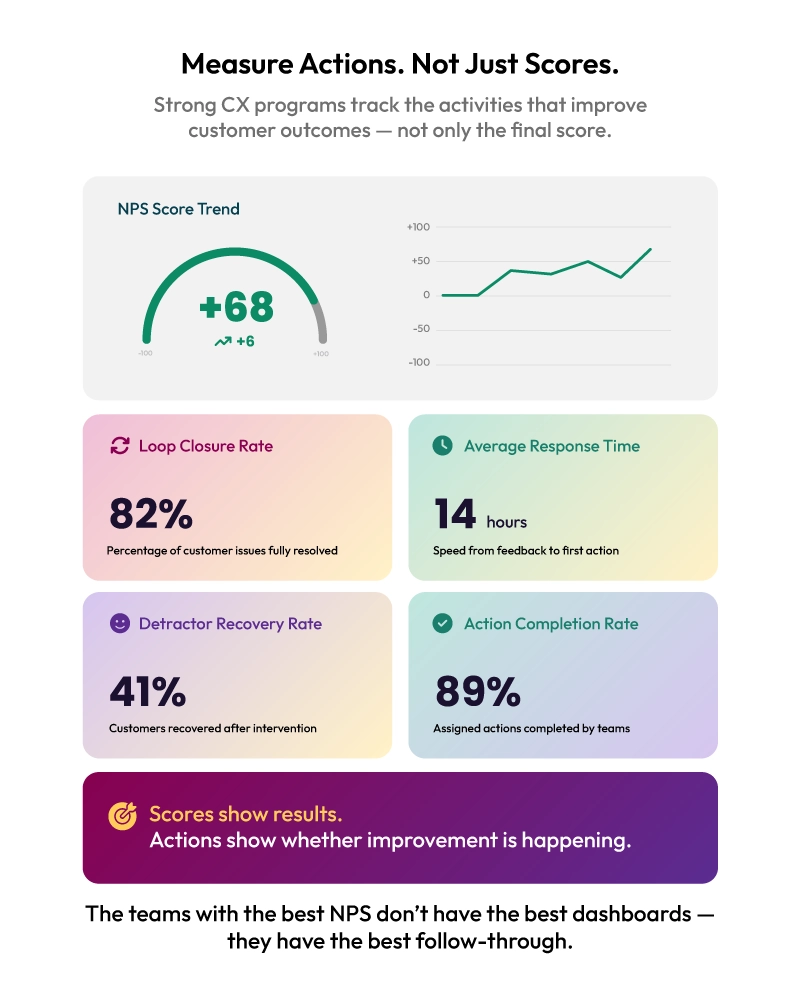
- Tracking NPS is not the same as improving it. The teams with the highest NPS scores are not the ones with the prettiest dashboards — they are the ones with a repeatable process for getting feedback to the person who can act on it, and measuring whether that action worked.
- The GetFeedback migration is not just a platform swap. It is a decision about whether you want to rebuild the same programme in a new tool or use the transition to build something that actually changes outcomes.
- The right replacement platform will have closed-loop workflows, frontline-level alerts, and action tracking built in — not as premium add-ons, but as the core of how feedback moves through the organisation.
Somewhere in your organisation right now, there is a beautiful NPS dashboard.
It has a trend line. It has colour-coded scores by region. It might even have a little gauge that turns green when the number goes up. Someone spent time configuring it. Someone else screenshots it every quarter for the board pack.
And almost nobody does anything with it.
This is not a dig. It is the most common failure mode in CX programmes, and it is so common precisely because it looks like success. The survey is running. The data is coming in. The dashboard exists. The boxes are ticked. And yet, somewhere underneath the trend line, the same complaints that appeared eighteen months ago are still appearing. The same touchpoints that produce detractors are still producing them. The NPS score moves up two points one quarter and down three points the next, for reasons that nobody can quite explain.
If your programme has been running on GetFeedback, you have until December 31, 2026 to find a replacement. That is a deadline. It is also, if you choose to use it that way, a rare opportunity to ask a question most CX teams never get a forcing function to ask: is the programme we have been running actually working?
The Uncomfortable Question Behind Every NPS Score
Here is the thing about NPS: it is an excellent leading indicator of customer loyalty. It is a terrible substitute for knowing what to do next.
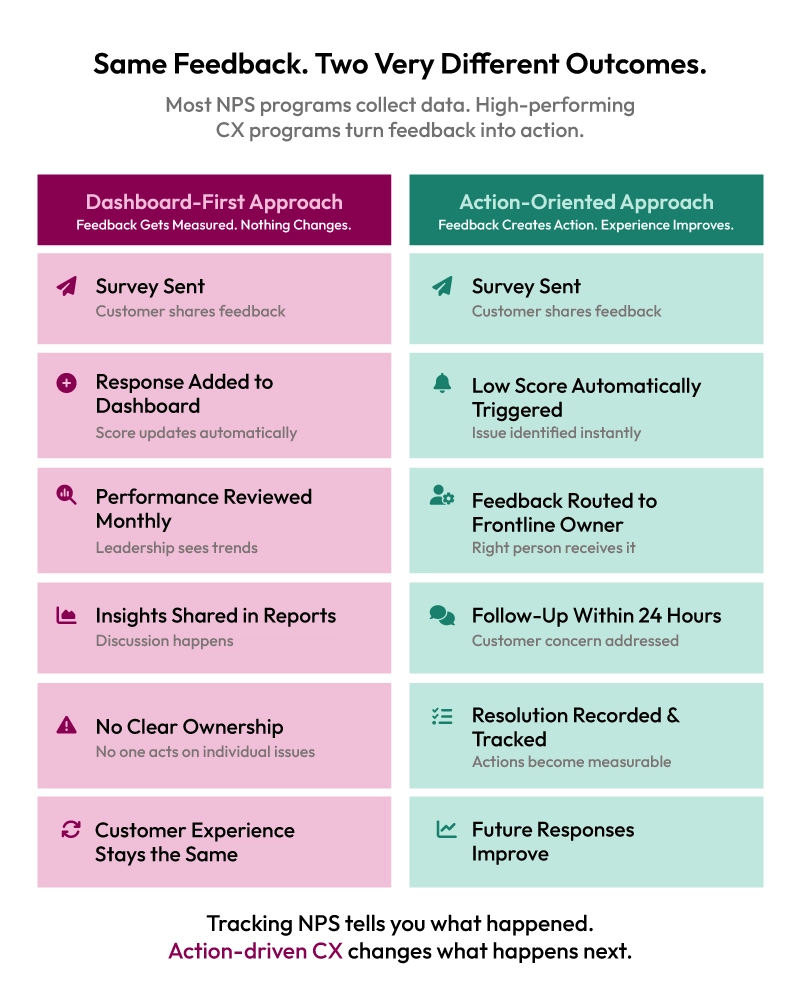
A score tells you how many of your customers are promoters and how many are detractors. It does not tell you which specific experience created a detractor last Tuesday, who should have been alerted, what action was taken, and whether that action worked. For that, you need a programme — not just a survey.
Most organisations running GetFeedback have a survey. Fewer have a programme. And the difference between the two shows up not in the score itself but in what happens the week after a score comes in.
If the answer to “what happened after the last batch of detractor responses came in” is “they appeared in the dashboard and the CX team reviewed them in the monthly meeting”, that is a survey. If the answer is “the operations lead at the relevant location was alerted within 24 hours, followed up with the customer, and the resolution was tracked against that customer’s subsequent survey response”, that is a programme.
The platform is not the whole difference between those two outcomes. But the platform either enables the programme or it gets in the way of it.
Five Reasons NPS Programmes Stop at the Dashboard
These are not abstract failure modes. They are the specific structural problems that produce beautiful dashboards and unchanged customer experiences.
1. Feedback reaches the wrong people
The most common dashboard in a GetFeedback deployment shows aggregate NPS by region, product, or customer segment, visible to the CX team, the head of operations, and the executive leadership team.
The person who served the customer last Thursday is not looking at that dashboard. The store manager, the centre director, the service team lead — the people who can actually change the experience — typically do not have access to the platform, or have access to a view that is too aggregated to be useful.
When feedback does not reach the frontline, the frontline does not change. It is not motivational failure. It is an information architecture problem.
2. Scores are tracked. Actions are not.
A 7/10 comes in from a customer who had a bad experience with a specific part of your service. It lands in the dashboard. The trend line moves slightly. Nobody tracks whether anyone spoke to that customer, what was resolved, or whether the underlying process was changed.
Six months later, a different customer has the same experience and submits a 6/10. The trend line moves again.
This is not customer experience management. This is customer experience measurement. The two are not the same thing, and most platforms — including most GetFeedback deployments — are set up for the second one.
3. Surveys fire at the wrong frequency
GetFeedback works best when survey triggers are configured thoughtfully against specific Salesforce events. In practice, many organisations either over-survey (every interaction, regardless of significance, generating survey fatigue and declining response rates) or under-survey (quarterly or biannual campaigns that capture a snapshot long after the experience has faded).
Neither extreme produces the kind of signal you can act on. The first produces noise. The second produces history.
4. There is no closed-loop process
Closed-loop feedback means: a customer submits a low score, someone is alerted, that person contacts the customer, the concern is addressed, and the resolution is recorded. It sounds simple. In most organisations, it does not happen.
The reason it does not happen is usually not willingness. It is that the platform does not make it easy. The alert does not go to the right person automatically. The response process is manual and inconsistent. There is no way to track whether the loop was actually closed or just marked as closed.
The result: detractors feel unheard. Unheard detractors churn. The NPS score reflects the churn, and the cycle repeats.
For a deeper look at why this matters, the guide to why closed-loop feedback drives customer advocacy covers the mechanics and the evidence.
5. The platform was chosen for its dashboard, not its action architecture
GetFeedback had excellent Salesforce integration and strong reporting. What it was less designed for was routing feedback to the right person automatically, tracking actions against individual responses, and measuring whether those actions changed subsequent scores.
This is not unique to GetFeedback. Most survey tools are built dashboard-first, action-second. The vendors with the best demo experiences tend to be the ones who have invested in the reporting layer — because that is what looks impressive in a 45-minute discovery call.
The question worth asking before you sign with any replacement platform is not “how does the dashboard look?” but “how does feedback get from a customer response to an action by the right person, and how do we know whether that action worked?”
The GetFeedback Migration as a Programme Reset
Here is the reframe that most migration guides do not offer.
You are not just replacing a tool. You are deciding what kind of CX programme you want to run for the next three to five years.
If your GetFeedback deployment was producing dashboards that informed quarterly presentations, you can migrate to a new platform and rebuild exactly the same programme. The surveys will still fire. The scores will still come in. The dashboard will look slightly different. Nothing else will change.
Or you can use the forced migration to ask: what would the programme look like if it was designed around action rather than reporting?
That question is harder to answer than “which platform has the best Salesforce integration.” But it is the question that separates CX teams whose programmes actually change customer outcomes from CX teams whose programmes produce interesting reading material.
The guide to the top challenges when running a VoC programme and how to build a VoC programme from feedback to action are worth reading before you finalise your requirements for any replacement platform — because the requirements you write will determine the kind of programme you end up with.
What an Action-Oriented CX Platform Does Differently
The structural difference between a reporting platform and an action platform comes down to three things.
- Feedback routing at the right level. An action-oriented platform does not just aggregate data for leadership. It routes specific feedback to the specific person who can act on it — the store manager for an in-store complaint, the service team lead for a support interaction, the centre director for a care-quality concern — automatically, without requiring a manual triage process in the middle.
- Closed-loop tracking built in, not bolted on. Every response that triggers a follow-up should have a traceable thread: who was alerted, what action was taken, when the loop was closed, and whether the customer’s subsequent score reflected the resolution. This should be a native part of the platform’s architecture, not a workaround built in Salesforce flows.
- Action metrics alongside score metrics. The teams with the best NPS trends are not necessarily the ones with the most sophisticated dashboards. They are the ones who track response rates, loop closure rates, and the correlation between closed loops and subsequent score changes. If your platform only measures scores, you are missing the leading indicators that actually predict whether scores will improve.
What to Look for in a GetFeedback Replacement That Actually Drives Action
If you are evaluating replacement platforms with this lens, here are the questions that separate action-oriented platforms from reporting platforms.
How does feedback reach frontline staff — automatically or manually?
If the answer involves a manual triage step, that step will become the bottleneck. Routing should be automatic based on configurable rules: location, score threshold, survey type, customer segment.
What does the closed-loop workflow look like at the operational level?
Ask to see the flow from low-score response to frontline alert to resolution tracking. If the demo skips straight from “survey fires” to “dashboard updates”, ask specifically about the middle part.
How do you measure whether action is being taken, not just whether data is coming in?
If the platform only reports on NPS scores, it is a measurement tool. If it also reports on response rates, loop closure rates, and resolution times, it is an action tool.
Who owns the integration and workflow configuration?
If the answer involves your IT team building and maintaining the routing rules, that is a resourcing commitment that often does not survive the first quarter post-go-live. Vendor-managed configuration means the system keeps working when the person who set it up changes roles.
For a structured evaluation framework, the NPS software buyer’s checklist with 47 questions covers the full range, and the guide to selecting a VoC platform helps frame the broader programme decision alongside the platform decision.
How Resonate CX Approaches This
Resonate CX is built around the action layer, not just the reporting layer.
Feedback routes to the right person at the right level automatically. Closed-loop workflows are native to the platform — not a configuration project your team inherits. Action metrics sit alongside score metrics as a standard part of the dashboard, not a premium add-on. And because the Salesforce integration is native rather than connector-based, the routing and workflow configuration does not depend on your IT team maintaining a connector that can break independently of both platforms.
The always-on customer experience guide covers what a programme built around continuous feedback and action actually looks like in practice — and the 4-step approach to turning customer data into insights gives you the operational framework for making that shift.
If you are migrating from GetFeedback and want to understand what an action-oriented programme looks like in your specific context, start with a conversation.
Run an AI-powered CX program beyond surveys
See our platform in action. A live demo tailored to your organization’s needs.








Neha Pal
More Articles
-
- Blog

Customer Experience Platform: 7 Options Compared + Buyer’s Guide for 2026
PwC’s 2025 Customer Experience Survey found that 70% of executives believe customer expectations are evolving faster than their organisations can adapt. That gap is why platform selection matters: another dashboard… -
- Blog
Complaint Experience Management Software: What Enterprise CX Teams Should Compare in 2026
Enterprise complaint programs rarely fail because teams cannot close a case. The harder problem is knowing whether the organisation is resolving the right issues, prioritising the right risks, and learning… -
- Blog
AI in Voice of Customer Programmes: Use Cases, Benefits and Best Practices
Understanding customers and prospects is fundamental to business success. By tapping into customer needs and expectations, businesses can make informed decisions that resonate with their audience.



Resonate CX Resources

The Definitive Guide to Choosing the Right CXM Software
Choosing the right CXM software takes strategy, requiring you to define goals, assess integrations, and select a long-term partner.
Why Invest in a CX Platform: A Strategic Move for Competitive Advantage
Discover why a CX platform drives better experiences, loyalty, and sustainable growth.
Should You Invest in a Customer Experience Management (CXM) Platform?
This guide walks through the five factors that determine whether now is the right time to invest.
How to Prove the ROI on CX to Your Board
Learn to prove ROI of Customer Experience by turning sentiment into revenue, retention, and risk insights.
4 Critical Signs You Need a New CXM Platform Solution
Is your CX platform holding you back? Data silos, stagnant metrics, slow insights, and poor integration signal it’s time to upgrade.
NPS Software Buyer’s Checklist: 47 Questions to Ask Vendors
NPS software helps you choose smarter with 47 key questions for better insights, workflows, and impact.
How to Combine NPS and Voice of Customer for a Complete CX Measurement System
Discover how NPS and VoC connect to turn feedback into loyalty and growth.
How Long Does CX Implementation Take? Timeline and Success Indicators
CX implementation timeline? Learn more about honest expectations and proven framework to accelerates success.