All of us have, at some point, received a text or email survey from our favourite service provider asking
“How likely are you to recommend us to a friend or colleague?”.
People across industries know this as the Net Promoter Score (NPS) question. This score calculates the likelihood of customers promoting your business by word-of-mouth. Furthermore, it is a powerful metric that has evolved over the last decade and is now a key business measure predicting and managing revenue growth.
What are the types of NPS?
Understanding the different types of NPS surveys is crucial for implementing an effective customer feedback strategy. Each type of NPS serves a unique purpose and provides distinct insights into your customer relationships.
The three main types of NPS are:
- Relationship NPS (rNPS) – Measures overall loyalty to your brand
- Transactional NPS (tNPS) – Captures feedback after specific interactions
- Episodic NPS (eNPS) – Evaluates experiences during defined periods or events
Let’s explore the three main types of NPS and when to use them.
Relationship or Brand NPS
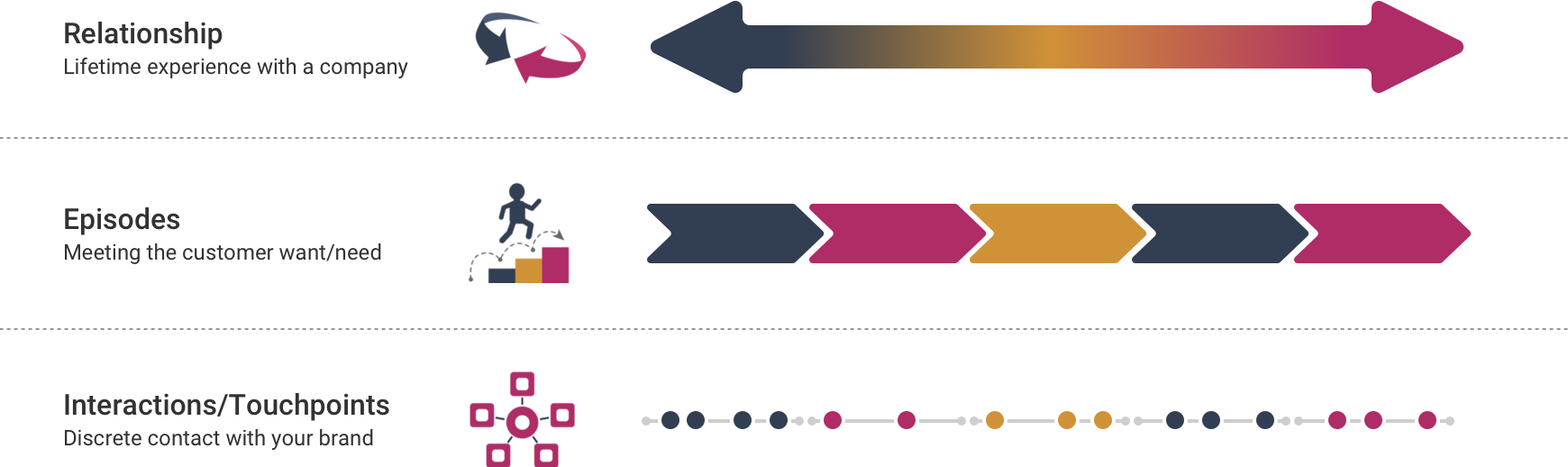
Firstly, this kind of NPS is a useful tool for measuring customer sentiment, loyalty, and advocacy towards your brand. It can help you understand the level of brand loyalty and advocacy among your customer base, regardless of the products or services you offer.
Companies often share their NPS number in their annual reports and use it as a benchmark for comparing their brand with their competitors. However, it’s important to note that the NPS doesn’t necessarily identify the specific experience that influenced the customers’ perception, such as a particular customer service call or product experience.
When to Use Relationship NPS
- Tracking long-term brand health and customer loyalty
- Quarterly or annual performance reviews
- Strategic planning and goal setting
- Comparing your NPS with industry benchmarks
Additionally, the NPS survey is sent at periodic intervals, such as quarterly, without a specific experience trigger.
Relationship NPS Example
A school would send out surveys to parents annually, or an airline to members of their loyalty program once a quarter, to understand if brand loyalty has shifted.
Use Relationship NPS when asking:
- How healthy are our customer relationships overall?
- Are we building long-term loyalty?
- How do we compare to competitors?
- What’s our growth potential through advocacy?
Episodic NPS
This type of NPS survey measures the experience after fulfilling a single customer need or want, which may involve multiple customer interactions or touchpoints. This can be when applying for a new internet connection at home, customers need to interact with the brand several times, and the survey is triggered when the entire journey is complete.
Typically, companies also include a “Why?” question to follow the NPS rating. This is an open-ended question, providing a space for customers to elaborate on why they gave that score. The verbatim responses offer invaluable insights on how to improve the customer experience and/or what customers value within an experience. Allowing organisations to make investment decisions.
When to Use Episodic NPS
This type of episodic metric is the most mature and customer-centric of all three NPS measures. It puts the focus on the customer episode / need rather than the various operational services in a company.
Customer touchpoints can include:
- After seasonal campaigns or promotions
- Following major product launches or updates
- During specific customer journey phases
- After participation in events or programs
The survey measures the customer experience at the end of meeting that need, determining whether the brand created an advocate and whether the customer would recommend the service to others for fulfilling a particular need.
Episodic NPS Example
“Please tell us why you gave this score?”
“Is there anything we can do to improve your experience?”
These insights are gold for executives and help them predict and prevent customer churn. Recurring themes may also flag the possible need for process change to be looked into to improve the customer experience (e.g. not enough changing rooms in a store or poor usability of an e-commerce website).
Use Episodic NPS when asking:
- Was this campaign/initiative successful?
- How did our seasonal performance compare?
- Should we run this program again?
- What worked (or didn’t) during this period?
Transactional NPS
The most granular of the NPS types, Transactional or Touchpoint NPS, focuses on a single interaction with the customer, and triggers after the interaction completes. This type of survey typically follows an independent experience. Transactional NPS differs from the Relational NPS as it is highly actionable, providing insights that drive continuous improvements in customer experience.
When to Use Transactional NPS
- Immediately after customer service interactions
- Following specific purchases or transactions
- After key touchpoints in the customer journey
- When testing new processes or features
Transactional NPS Example
For instance, if an airline scores lower on the NPS survey for a particular route, the airline can improve the service for that specific experience to match customer expectations. Similarly, if the organisation observes that customer service in the contact centre scores lower on the NPS survey at a particular time of the week, they can look to train the staff or increase staffing during that specific time.
Transactional NPS scores provide the highest level of granularity for action and insights, making them the most effective form of NPS measurement.
Use Transactional NPS when asking:
- How well did this specific interaction go?
- Which touchpoints need immediate attention?
- Is this team/channel performing well?
- Can we recover this customer right now?
Comparing the Three Types of NPS: Which Should You Use?
| RELATIONSHIP NPS | EPISODIC NPS | TRANSACTIONAL NPS (CSAT) | |
| Best For | Strategic planning | Operational improvements | Seasonal insights |
| What does it measure? | Measures -brand sentiment and advocacy | Measures how well a particular customer need was met and whether you created a promoter or detractor in meeting this need. | Measures customer experience or a particular experience |
| Frequency | Predetermined time intervals, normally quarterly | Triggered after meeting a particular customer need e.g., Loan settlement, Home internet connectivity | Triggered after the completion of a single experience |
| Timing | Periodic intervals | End of episode/period | Immediately post-interaction |
| Sample Question | Based on our overall relationship, how likely are you to recommend [company name] to a friend or colleague? | Based on your recent request for a new internet connection, how likely are you to recommend [company name] to a friend or colleague? | Based on your recent purchase at store X, how likely are you to recommend [company name] to a friend or colleague? |
| User examples | Customers’ overall relationship with a Bank Schools relationship with parents Commercial Property Owners with tenants | Resolving a customer complaint Completing a school enrolment Requesting new internet connections | Ordering home-delivery Talking to a customer representative in a contact centre Making a sales enquiry |
If you want an introduction to creating a CX Program, check out the linked resource.
Uses of NPS
NPS is a powerful methodology and has been adapted to not just measure Customer Experience, but also:
- Employee Experience – How likely your employees are to promote the company as a good-place-to-work
- B2B Experience – How satisfied your vendors or business partners are
- Product Experience -How satisfied users are with the product or product updates
- Service Experience – How satisfied your customers are with your service delivery
Your use of the NPS is not limited to just one of them, you can actually combine all of them for a longer, more strategic approach.
How the Types of NPS Work Together
The real power comes from using multiple types of NPS strategically. Here’s how they complement each other:
Example: SaaS Company
- Relationship NPS (quarterly): Shows overall loyalty is 55 (good)
- Transactional NPS (onboarding): Reveals onboarding experience is 72 (excellent)
- Transactional NPS (support): Shows support experience is 31 (poor—problem identified!)
- Episodic NPS (product launch): Q4 feature launch scored 48 (decent but not great)
Insights from combined data:
- Strong onboarding is creating good first impressions (high tNPS)
- But poor support is eroding that goodwill over time (low support tNPS)
- Overall loyalty (rNPS 55) is being held back by support issues
- The recent product launch didn’t excite users as much as hoped (eNPS 48)
Action plan:
- Immediate: Fix support issues (improve training, reduce wait times)
- Short-term: Enhance support tNPS to match onboarding performance
- Medium-term: Apply learnings from high-performing onboarding to other touchpoints
- Strategic: Monitor if support improvements lift overall rNPS in the next quarter
This is the comprehensive view you get when leveraging all three types of NPS together.
It is no wonder that NPS surveys are now a driving force for growing companies, and most companies use multiple types of NPS surveys targeted at distinct internal and external stakeholders. Its insights afford managers the potential to measure and improve NPS in multiple experiences, and that is a game-changer in driving customer growth and revenue.
Breakthrough Customer Experience with Resonate CX
If you’re looking to break through with a Customer Experience program that is more connected and insight-driven, explore how Resonate CX can help you utilise NPS programs within your business.
Resonate CX has worked with the likes of Expedia to help launch their CX programs from the ground up and even elevate their CX programs to the next level.
The success of Expedia’s loyalty efforts underscores the critical value of Transactional NPS (tNPS), specifically leveraging post-trip customer experience feedback to shape business strategy. They didn’t just track a general score; they employed advanced text analytics on the rich, post-travel comments to instantly identify product and service gaps.
The resulting actionable insights, driven by real-time dashboards, allowed Expedia to refine services, consistently maintain high service quality across all booking types, and implement simple, targeted tactics to boost customer loyalty and encourage repeat business.
Request a Demo with Resonate CX Today
In Resonate CX, these different types of NPS surveys are brought together into one connected system through the Customer Experience Platform. This allows teams to understand customer sentiment at every CX program phase.
From Relationship, transactional, and in-moment NPS responses are automatically linked with behavioural data, support interactions, and qualitative feedback. This is to give you a clearer view of what’s driving loyalty and helps teams prioritise improvements based on real customer insights rather than assumptions.
Explore how Resonate CX can help you utilise NPS programs within your business today!