- Customer Experience
- |
- Featured
GetFeedback Alternatives for 2026: Best NPS Software Guide
Aryne Monton
|
11 May 2026
TLDR:
- The best NPS software in 2026 is not the platform that looks most like GetFeedback — it is the one that eliminates the limitations GetFeedback had. Real-time delivery, frontline usability, AI-powered analytics, and closed-loop action are the capabilities that separate high-performing CX programmes from expensive dashboards.
- The biggest evaluation mistake is optimising for similarity. Teams that use the GetFeedback migration to ask ‘what do we wish our platform could do?’ will come out of 2026 with a fundamentally stronger CX capability than teams that just rebuild what they had.
- Five questions determine which platform is right: How fast can you go live? Who will use it daily? Does it close the feedback loop? Does it explain the why behind scores? What does ROI look like in 90 days? If a vendor cannot answer all five clearly, keep looking.
- Resonate CX is purpose-built as an action-first customer experience management platform — live in 3 weeks, powered by Robyn AI and Risk Radar, proven across retail, childcare, real estate, and utilities to deliver measurable ROI within one quarter.
- The right migration partner handles the transition end-to-end: survey continuity, Salesforce integration, historical data, team training, and ongoing support. Do not sign with a vendor that treats implementation as the customer’s problem.
Deadline: GetFeedback Direct retires on 31 December 2026. Delighted closes on 30 June 2026. If either is part of your CX stack, the window to plan a good migration, rather than a rushed one, is closing.
GetFeedback alternatives are now a priority for CX teams preparing for the retirement of GetFeedback Direct on 31 December 2026 and Delighted on 30 June 2026. Organisations evaluating replacement platforms are not just searching for another survey tool — they are searching for the best NPS software to improve real-time insights, frontline adoption, and closed-loop customer experience management.
If your team is evaluating GetFeedback alternatives, this guide explains how to compare modern NPS platforms, what capabilities matter most in 2026, and how to avoid rebuilding the limitations of legacy feedback systems.
GetFeedback was built for a specific purpose: clean survey design, solid Salesforce integration, and consistent NPS collection. It did those things well. But the demands placed on customer experience management software have moved significantly.
The teams making the smartest GetFeedback migration decisions are not asking ‘what is the closest replacement?’ They are asking ‘what did we wish our feedback platform could do?’ That question changes the evaluation entirely.
According to Forrester Research, customer experience leaders grow revenue at more than four times the rate of CX laggards. The platform you choose next is not just an IT decision but a growth infrastructure decision.
This guide gives you the evaluation framework to make that decision confidently: the five questions that matter most, a side-by-side capability comparison, and a clear look at what the best experience management and insights platforms now deliver. Before you commit to a direction, read this first.
Real organisations. Real outcomes. Act in real time.
Why CX Teams Are Actively Searching for GetFeedback Alternatives Right Now
The search for GetFeedback alternatives has accelerated significantly. According to Gartner, more than 80% of companies now compete primarily on the basis of customer experience — elevating CX from a support function to a commercial growth lever. The tools required to support that shift are fundamentally different from the survey platforms built five years ago.
What the Best GetFeedback Alternatives Need to Improve
Before evaluating what comes next, it is worth being honest about what made GetFeedback valuable, and what it was never designed to do.
What GetFeedback did well:
Salesforce-native integration — feedback data lived inside the CRM without middleware or sync complexity
Clean, simple survey design — NPS, CSAT, and CES surveys that teams could launch quickly
Reliable response collection — consistent feedback capture across customer touchpoints
Accessible price point — genuinely useful for mid-market teams without enterprise research budgets
Where modern CX needs have evolved beyond it:
No real-time delivery — insights arrived in reporting cycles, not the moment feedback was submitted
Limited text analytics — open-ended responses required manual review; the ‘why’ behind scores was invisible at scale
Executive-only dashboards — the platform was not built for frontline teams to use in daily operations
No predictive risk capability — issues were identified after they appeared in scores, not before they became churn
No closed-loop management — feedback was collected and reported, but the operational response was left to the team to manage manually
This is not a criticism of GetFeedback. It was built for the CX needs of its time. The retirement is an opportunity to replace it with a platform built for the CX needs of now. Read more on when this shift becomes necessary: 4 Critical Signs You Need a New CXM Platform Solution.
The Core Shift: From Score Delivery to Action Delivery in the Best NPS Software
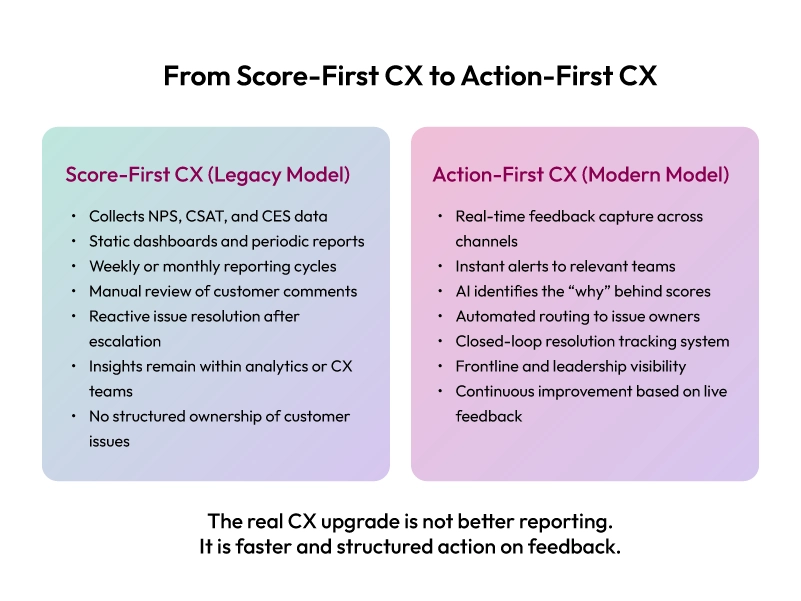
The most important conceptual shift in evaluating best NPS tools in 2026 is understanding the difference between a score-first platform and an action-first platform.
A score-first platform – which describes most feedback tools of the GetFeedback era — is optimised to collect feedback and report the score accurately. It does its job when the NPS number lands in the dashboard correctly.
An action-first platform is optimised for what happens after the score arrives. Who sees it? What do they do with it? How fast does the issue get resolved? How does the resolution affect the next score?
According to Bain & Company, a 5% increase in customer retention produces a 25 to 95% increase in profit. That improvement does not come from measuring NPS more accurately. It comes from acting on what the score reveals — faster, more specifically, and more consistently.
That is the lens through which the best experience management software should be evaluated. Not ‘does it collect NPS?’ Every platform does that. But ‘what does it do with the NPS once it arrives?’
For more on how closed-loop action changes CX outcomes, read Closing the Loop Is Essential to Driving Customer Advocacy.
The best GetFeedback alternatives do more than replicate surveys and dashboards. Modern CX platforms combine AI-powered analytics, real-time operational visibility, and closed-loop workflows that help teams act on customer feedback immediately.
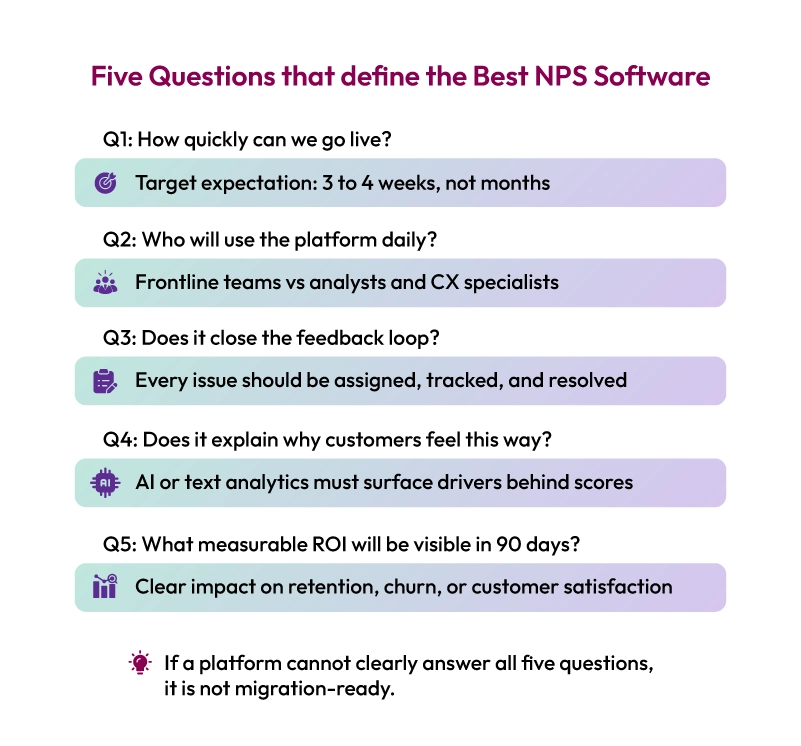
The 5 Questions That Should Drive Your Best NPS Software Evaluation
Use these five questions as your evaluation framework — not a feature checklist, but the criteria that reveal whether a platform will actually improve your CX programme or just replicate what you had.
Question 1: How Quickly Can We Go Live?
Under a 2026 retirement deadline, implementation speed is a strategic priority. Any platform that requires a six-month professional services engagement is not a viable migration option. The best best NPS survey tools in 2026 offer guided onboarding, pre-built integrations, and a dedicated implementation partner that gets teams live in three to four weeks.
Ask in the demo: ‘Can you show us a client who was live within four weeks? What did their week-one look like?’
Related: 5 Tips to Launch Your CX Programme
Question 2: Who on My Team Will Actually Use It Daily?
The most expensive failure in experience management and insights platforms is a tool designed for analysts and executives that frontline teams never open. Ask specifically to see the frontline view — what does a store manager, centre director, or field operations lead see when they log in on their phone before a morning huddle?
Ask in the demo: ‘Show me the mobile view for a frontline manager. What action can they take from that screen?’
Related: Closed Loop Feedback Empowers the Frontline
Question 3: Does It Close the Feedback Loop?
Collecting feedback is the beginning of the process. The metric that separates high-performing CX programmes from expensive dashboards is whether the feedback loop closes — meaning the customer signal creates a traceable response, resolution, and record. Harvard Business Review found that acquiring a new customer is 5 to 25 times more expensive than retaining an existing one. Closed-loop feedback is the operational mechanism that makes retention scalable.
Ask in the demo: ‘Show me how a 3-star NPS response gets routed, owned, resolved, and recorded in your platform.’
Related: How to Improve the Customer Experience: Closing the Loop
Question 4: Does It Explain the Why Behind the Score?
An NPS score tells you how customers feel. It does not tell you why. Text analytics — specifically natural language processing applied to open-ended feedback — converts a score into an actionable diagnosis. The best best NPS software in 2026 includes built-in AI that automatically categorises themes, surfaces sentiment shifts, and connects verbatim responses to operational triggers. Without this, your team spends hours manually reading comments and still misses the signal.
Ask in the demo: ‘Show me how open-text feedback is categorised. How do I see what topics are trending without reading every comment?’
Related: A Beginner’s Guide to Text Analytics
Question 5: What Does ROI Look Like in 90 Days?
The difference between a platform that proves its value in the first quarter and one that promises returns ‘over time’ is usually the difference between adoption and abandonment. The best customer experience management software comes with a clear picture of what measurable improvement looks like in the first 90 days — not a theoretical outcome, but a reference customer result from your industry.
Ask in the demo: ‘Show me a client in our industry who migrated to your platform. What did their first 90 days look like, and what changed measurably?’
Related: Benefits of CX as a Competitive Advantage
GetFeedback Era vs Modern Experience Management Software — The Capability Framework
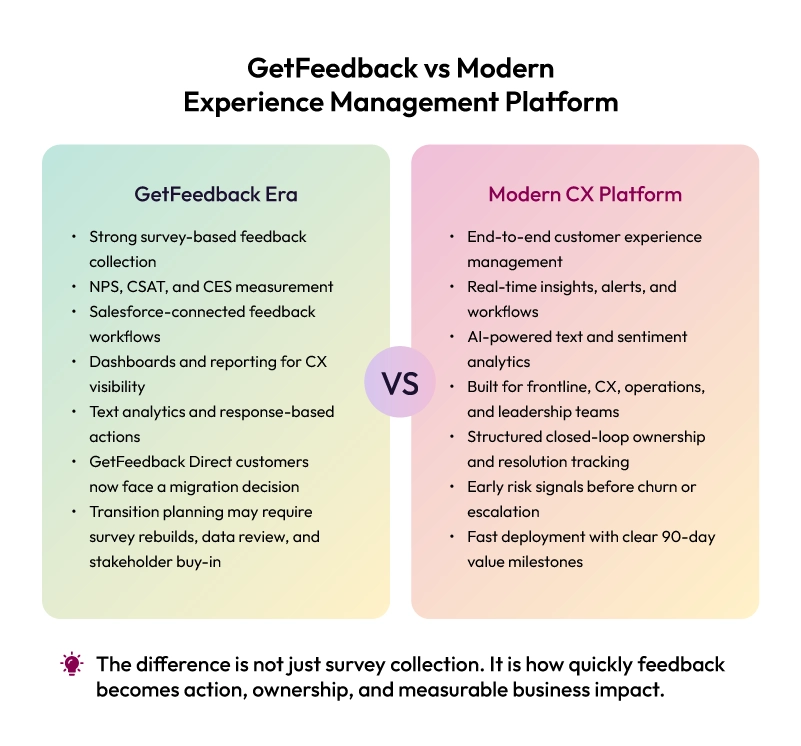
Use this table to assess any platform you evaluate. Every capability in the right column represents a real gap that most GetFeedback users experienced — and a concrete upgrade opportunity in the right experience management software.
GetFeedback Era |
Modern Experience Management Software |
|---|---|
|
Feedback collection only |
Closed-loop action management |
|
Batch/periodic reporting |
Real-time dashboards and instant alerts |
|
Manual open-text review |
AI-powered text analytics (Robyn AI) |
|
Executive-level dashboards |
Frontline CX Gym + mobile access for all teams |
|
Historical NPS tracking (self-benchmark) |
CX Benchmarking vs industry peers |
|
Manual risk monitoring |
Risk Radar — automated early warning system |
|
3–6 month implementation |
Live in 3 weeks — dedicated CSM from day one |
When evaluating vendors, use this table as a checklist. Ask for a live demonstration of each capability in the right column — not a slide, not a roadmap promise. If a vendor cannot demonstrate closed-loop management, AI text analytics, and real-time dashboards in a 30-minute demo, those capabilities are either not built yet or not built well.
For a full comparison of CXM vs survey tools: CXM Platform vs. Survey Maker
Why the GetFeedback Migration Is Your Best Chance to Build a Better VoC Programme
Most CX leaders spend years building the case for a platform upgrade. The argument – ‘our current tool works but a better one would improve results’ — rarely wins budget approval as a standalone pitch.
A platform retirement changes that dynamic entirely. The migration has to happen. The decision is not whether to switch — it is to what. And that question is the most valuable CX conversation a leader can have this year.
According to McKinsey & Company, companies with consistent, high-performing customer experience grow revenue at twice the rate of those with inconsistent delivery. The GetFeedback migration is a legitimate business case for building the infrastructure that makes consistent CX delivery possible.
Teams that approach this migration as an upgrade — rather than a like-for-like swap – will have a structural CX advantage over competitors who simply rebuild what they had.
For the full framework on what a high-performing VoC programme looks like: How to Build a VoC Programme: From Feedback to Action
Why Resonate CX Is One of the Strongest GetFeedback Alternatives
Resonate CX is built as an NPS and Voice of Customer platform that prioritises action over analysis. It is a purpose-built customer experience management platform designed to move teams from feedback collection to frontline action in the shortest possible time — which makes it the most commercially relevant platform for CX leaders working against a 2026 migration deadline.
Real-Time Insight — Not Weekly Reporting Cycles
Feedback in Resonate CX surfaces the moment it is submitted — visible to the right team members immediately, not in a report the following week. This single capability change is what converts a CX programme from a measurement exercise into an operational tool. Read how this works: Customer Experience Data Integration: Connecting Feedback to Action.
Robyn AI — The Intelligence Layer That Replaces Manual Analysis
Robyn AI processes every piece of feedback in real time, categorising themes, surfacing sentiment shifts, and connecting verbatims to operational triggers automatically. Ask Robyn a question in plain language — ‘what is driving our score drop in the north region this week?’ — and get an immediate answer from your data. No analyst. No report request. No waiting.
Risk Radar — Early Warning Before Issues Become Churn
Risk Radar monitors experience data continuously and flags operational risks the moment they surface — before they escalate into complaints, churn, or reputational damage. For multi-location businesses, this is the capability that connects frontline signals to leadership decisions before the score moves.
Frontline CX Gym — Insights That Reach the People Who Act on Them
Frontline CX Gym gives store managers, centre directors, and field teams a dedicated view of what their customers are saying right now — on mobile, in plain language, with no dashboard navigation required. This is the capability that closes the adoption gap between executive reporting and operational improvement.
CX Benchmarking — See Where You Stand in the Market
CX Benchmarking compares your NPS and satisfaction scores against industry peers rather than just your own historical data. For CX leaders making the case to leadership that the migration investment was worthwhile, this turns internal scores into competitive credibility.
Live in 3 Weeks — The Most Important Number Under a 2026 Deadline
Resonate CX implementations are guided, fast, and require minimal internal technical resource. Survey design, data connections, integrations, and dashboards are all handled within the platform and guided by a dedicated Customer Success Manager. Most clients are live and generating actionable insights within three weeks of starting.
For VoC partner selection guidance: 3 Tips for Selecting a CX and VoC Programme Partner
Proven Migration Results — Across Multiple Industries
Total Tools (Retail): 140 NPS responses per month became 15,000. 80% weekly active adoption. CX embedded in daily store operations.
TasNetworks (Utilities): 10-year-old system replaced. Feedback volume increased 1,700–3,400%. Reporting lag went from 2 months to real time.
Thrive Early Learning: Tripled number of centres while maintaining consistent CX quality — driven by daily live feedback across the network.
Busy Bees Aotearoa: World-class NPS maintained across hundreds of centres with a multi-touch programme built on Resonate CX.
If you are evaluating whether your organisation is ready for a full CX platform, the checklist in 10 Obvious Signs You’re Ready for a CX Management Platform will confirm it quickly.
Who Should Own This Decision — And What Each Stakeholder Needs to Know
The GetFeedback migration involves multiple stakeholders with different priorities. Here is how to align them:
Persona |
Primary Need |
Best Message |
|---|---|---|
|
Head of CX / VoC |
Continuity + better insight |
Use the switch to upgrade your entire CX programme |
|
Customer Insights / Research |
Survey history and benchmarks |
Protect data continuity — and add AI on top. |
|
Salesforce Admin / CRM Manager |
Integrations and data structure |
Native Salesforce integration, zero middleware. |
|
Customer Ops / Contact Centre |
Closed-loop alerts and resolution |
Move from feedback collection to real-time action. |
|
Marketing / Customer Engagement |
NPS, CSAT, retention |
Understand what customers say — and act on it fast. |
Not sure if your team is ready for a full CX platform upgrade? 10 Obvious Signs You’re Ready for a CX Management Platform is worth reading before your first vendor conversation.
Four Migration Mistakes to Avoid When Replacing GetFeedback
1. Choosing the Most Similar Tool by Default
Similarity is not the same as fit. A platform that looks like GetFeedback will replicate GetFeedback’s limitations. Evaluate on the five questions above — not on interface familiarity.
2. Migrating Surveys Before Defining What You Actually Need
Before rebuilding surveys, audit what you have and what is actually driving decisions. Most GetFeedback programmes have surveys that were set up years ago and never revisited. The migration is the right time to redesign — shorter surveys, better timing, smarter questions. Challenges When Running a VoC Programme explains the most common design mistakes to avoid.
3. Underestimating the Data Migration Timeline
Historical benchmark data, survey response history, and Salesforce data connections all need structured migration. Confirm explicitly with any vendor: what does data migration look like? How long does it take? What gets preserved and what does not?
4. Treating Implementation as an IT Project
The most successful GetFeedback migrations treat the switch as a CX programme redesign, not a technology swap. The right platform partner guides the whole journey — survey strategy, team adoption, reporting design, and ongoing improvement. How to Improve NPS: Proven Strategies to Boost Your Score gives the programme design context that makes the migration investment pay off.
The Right Platform Is Not the Most Similar One — It Is the One That Fixes What Was Missing
GetFeedback did its job. Now the job description has changed. The best NPS software for your team is not the platform that replicates what GetFeedback was — it is the one built for what CX programmes need to be in 2026: real-time, action-first, frontline-usable, and commercially accountable within a quarter.
Use the five-question framework before you commit to any platform. Demand live demonstrations, not slides. Ask for reference customers in your industry. And treat the migration as the upgrade opportunity it actually is.
Frequently Asked Questions
What is the most important thing to look for in a GetFeedback replacement?
The single most important capability shift is from batch reporting to real-time insight delivery. GetFeedback reported scores — the best NPS software in 2026 surfaces insights the moment they arrive, routes them to the right person, and tracks whether action was taken. Every other capability gap — text analytics, frontline usability, risk monitoring — compounds the value of that core shift.
How is experience management software different from NPS survey tools?
NPS survey tools collect and report Net Promoter Score data. Experience management software — also called customer experience management software or a CX platform — goes further: it integrates multiple feedback types, operational data, AI-powered analytics, frontline workflows, benchmarking, and closed-loop management into a single platform. The difference is the gap between a measurement system and an action system.
Can Resonate CX import our historical GetFeedback data?
Yes. Resonate CX’s migration process includes structured support for historical data export and import, ensuring your NPS benchmark history, response records, and trend data are preserved across the transition. This is confirmed as part of the implementation scoping process.
What is the difference between the best NPS tools and the best NPS survey tools?
Best NPS tools refers to the broader category of platforms that manage NPS programmes end-to-end — collection, analysis, action, and benchmarking. Best NPS survey tools typically refers more narrowly to the collection mechanism. In 2026, the most valuable platforms in both categories have converged: the best NPS survey tools are also action-first platforms, not just collection engines.
How quickly can Resonate CX be live for a GetFeedback migration?
Most Resonate CX migrations are completed in three to four weeks, including survey rebuilding, Salesforce integration setup, dashboard configuration, and team training. The process is guided by a dedicated Customer Success Manager from day one. For teams with Delighted’s tighter June 2026 deadline, this timeline is well within the available window.
What happens to our NPS benchmarks if we switch platforms?
With a well-managed migration, your NPS benchmark history is preserved and importable into the new platform. The more significant question is whether your new platform gives you better benchmarking capability going forward — specifically the ability to compare your scores against industry peers, not just your own historical data. Resonate CX’s CX Benchmarking capability provides exactly that.
Run an AI-powered CX program beyond surveys
See our platform in action. A live demo tailored to your organization's needs.







About the Author
Aryne Monton
More Articles
-
Blogs

- Customer Experience
- |
- CX Tips
- |
- Voice of the Customer
Top 3 Challenges When Running a VoC Programme And How To Avoid Them
By Alvier Marqueses• 12 May 2026In our previous blog, we explored the building blocks of launching a CX programme and getting your Voice of the Customer (VoC) initiative off the ground. -
Blogs
- AI
- |
- Customer Experience
- |
- CX Insights
- |
- General
AI Customer Experience: What Actually Works (and What Doesn’t) in 2026
By Alvier Marqueses• 11 May 2026AI excels at high-volume work, struggles with empathy. The honest playbook for CX teams who want results without the hype. -
Blogs
- Customer Experience
- |
- Feedback Management
- |
- Retail
- |
- Voice of the Customer
How to Improve Customer Experience in a Restaurant: 7 Proven CX Strategies
By Alvier Marqueses• 8 May 2026Improving restaurant customer experience comes down to more than food quality: service warmth, speed, complaint recovery, and acting on feedback are what separate the restaurants guests return to.