TLDR:
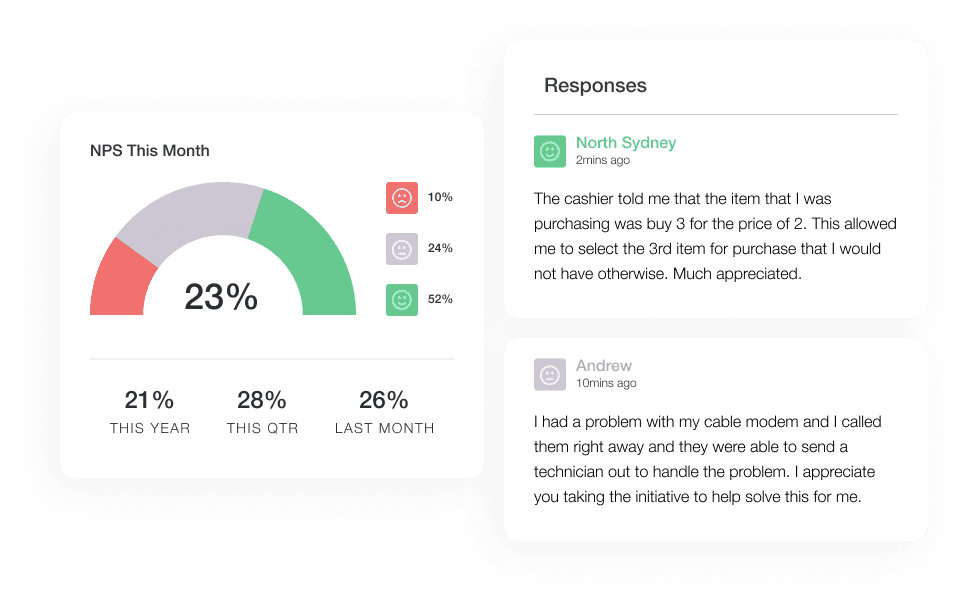
- NPS detractors are customers who score 0 to 6 on the Net Promoter Score question, unhappy enough to churn and vocal enough to discourage others
- They’re not lost yet. A detractor who responded to your survey is still in the relationship, still giving you a chance to make it right
- The root cause of most detractor scores is identifiable, but only if you have the right tools to analyse feedback at scale
- A structured closed-loop process is the single most effective lever for detractor recovery, and recovered detractors become your most loyal customers
- Robyn AI and Risk Radar help surface detractor themes and flag at-risk accounts before the score drops
If you’re running an Net Promoter Score (NPS) program, you’re familiar with the feeling. The score comes in, and there it is, a cluster of 0s, 2s, and 5s sitting in your detractor segment.
The instinct for most CX teams is to feel anxious about it, flag some responses for follow-up, and hope the ratio improves next quarter. The problem? Most detractors are never contacted. Most feedback is never acted on. And most businesses repeat the same mistakes because they’re treating detractors as a number to manage rather than a signal to act on.
Here’s what the research shows: when a detractor’s complaint is resolved well and quickly, they become more loyal than customers who never complained in the first place. It’s a consistent finding across industries. The opportunity inside your detractor segment is real. You just need the right process to unlock it.
This guide covers everything: what NPS detractors are, what’s actually driving them, how to identify patterns at scale, and how to build a recovery process that converts unhappy customers back.
What Is an NPS Detractor?
The Net Promoter Score question asks customers one thing: “How likely are you to recommend us to a friend or colleague?” on a scale of 0 to 10.
Based on their answer, respondents fall into three groups:
- Promoters (9 to 10): Loyal enthusiasts who actively recommend you
- Passives (7 to 8): Satisfied but not enthusiastic, unlikely to recommend, unlikely to churn in the near term
- Detractors (0 to 6): Unhappy customers who are at risk of leaving and may actively discourage others from choosing you
Your NPS is calculated by subtracting the percentage of detractors from the percentage of promoters. Every detractor doesn’t just drag your score down, they drag it down twice: once by not being a promoter, and again by inflating the detractor count.
A detractor isn’t a lost customer
This is the part most CX teams miss. A detractor scored 0 to 6, but they still responded to your survey. They’re still in the relationship. They’re still giving you a chance to fix things.
A truly lost customer doesn’t respond at all. A detractor is telling you something is wrong. Treat that as the opportunity it is.


CX Guides | free to download
No fluff. Just CX strategy guides for real-world use. Get tips from the experts.
Why NPS Detractors Matter More Than You Think
Promoters are satisfying to see in a report. But detractors are where the real business risk, and the real business opportunity, lives.
The churn risk is significant
Research published by Harvard Business Review found that acquiring a new customer costs between 5 and 25 times more than retaining an existing one. A detractor segment that isn’t being actively recovered represents significant revenue at risk, customers who are weeks or months away from churning silently.
Negative word of mouth travels further than positive
Frederick Reichheld, who developed the Net Promoter Score at Bain & Company, documented that detractors spread negative word of mouth to roughly twice as many people as promoters spread positive. In a world where online reviews and social media give every customer a platform, an unresolved detractor doesn’t just leave, they leave loudly.
Recovered detractors become your most loyal customers
This is the service recovery paradox, and it’s well-documented in CX research. When a customer with a complaint has it handled quickly, personally, and to their satisfaction, their loyalty often exceeds that of customers who never had a problem. The act of being heard, taken seriously, and made right for creates a stronger impression than an experience that was simply fine all along.
The key phrase is “quickly and personally.” An automated thank-you email sent four days after the survey doesn’t qualify.
What Actually Turns Customers Into Detractors
Before you can recover detractors, you need to understand what’s creating them. There are generally three categories:
- A specific failure at a key touchpoint
Something went wrong, a delivery, a service interaction, a product issue, a billing error. This type of detractor is the most recoverable. The cause is clear, the fix is achievable, and a genuine resolution is meaningful to the customer. - An accumulated series of small frictions
Nothing catastrophic happened. But over time, small frustrations built up, slow response times, inconsistent communication, a product that doesn’t quite do what was promised. These are harder to identify because no single incident stands out, and the customer often struggles to articulate what went wrong.
This is where Robyn AI becomes critical. It analyses open-text detractor responses to surface recurring themes that individual case managers would miss, the phrases appearing across hundreds of responses that, once identified, point directly at a systemic problem. - An expectation gap
The customer expected something different, different service levels, different responsiveness, different product capability. They’re not saying your business is terrible. They’re saying it’s not what they thought they were getting. This type of detractor often comes from a misalignment in the sales or onboarding process, not the service delivery itself.
How to Identify Your Detractors Before They Drift
The biggest challenge with NPS detractors is timing. Most programs survey quarterly or monthly. By the time a detractor is identified, weeks may have passed since the experience that triggered the score. At that point, the window for a meaningful recovery conversation is closing fast.
Risk Radar addresses this by monitoring account health signals between survey cycles, flagging customers who are showing at-risk behaviour patterns such as reduced engagement, declining usage, or service escalations, before the next NPS survey confirms the problem. This gives CX and account management teams the chance to reach out proactively, before the score drops and before churn becomes likely.
If you’re still relying purely on survey data to identify at-risk customers, you’re always working with yesterday’s signals.
The Closed-Loop Process for NPS Detractors
Closing the loop means more than acknowledging the score. It means taking responsibility, investigating the cause, acting on it, and letting the customer know what changed. Done well, it’s the single most effective lever in your NPS program.
Who should close the loop
For B2B businesses, the account manager or customer success manager owns this conversation. For B2C, a CX-trained team member should be assigned. Whoever closes the loop needs the authority to actually resolve something, not just send an apology.
How fast is fast enough
Best practice is a response within 48 hours of a detractor survey submission. Beyond 72 hours, recovery rates drop sharply. The faster the follow-up, the more the customer feels their feedback was taken seriously rather than processed in a batch.
The three-part recovery conversation
Effective detractor recovery consistently follows the same structure:
- Acknowledge: Thank the customer genuinely for their feedback. Don’t be defensive. Don’t explain away the problem yet.
- Investigate: Ask specific questions about what happened. Show you want to understand their experience, not just tick a resolution box.
- Act and follow up: Do something tangible. Then tell the customer what you did and why. Follow up 2 to 4 weeks later to confirm the experience has improved.
Tracking and measuring the loop
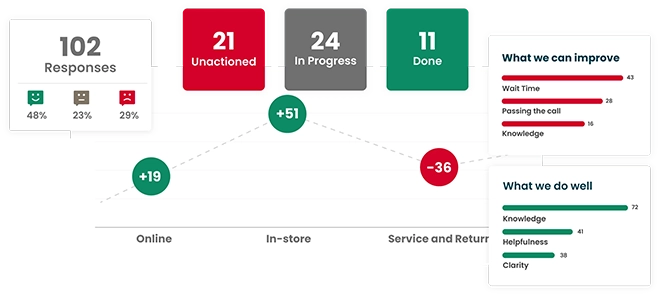
Resonate’s closed-loop feedback workflow assigns each detractor response to a team member, tracks resolution status, and feeds outcome data back into the NPS program. This means you can measure not just how many detractors you contacted, but how many were recovered, and tie that directly to retention outcomes. The importance of closed-loop feedback to customer advocacy is well established: businesses that close the loop consistently see measurably higher retention rates than those that treat NPS as a reporting exercise.
How to Win Back NPS Detractors
Recovery patterns that work share consistent characteristics: they’re personal, fast, and specific to the customer’s actual experience, not a generic script.
What doesn’t work: automated reply emails, requests to re-rate before the issue is resolved, or apologies with no follow-through action.
Research from Bain & Company’s service recovery work shows that customers don’t just want the problem fixed, they want acknowledgement that it shouldn’t have happened. The emotional resolution matters as much as the practical one.
Timeframe expectations are realistic: most recoveries happen within 30 to 90 days if the loop closes quickly. A detractor contacted within 48 hours who saw a tangible change is significantly more likely to score 7 or above in the next survey cycle.
Measuring the ROI of Your Detractor Recovery Program
A closed-loop detractor process isn’t a cost. It’s an investment with a measurable return.
Detractor conversion rate
What percentage of contacted detractors move to passive or promoter on the next survey? Programs with a structured, fast closing-the-loop process typically see conversion rates of 20 to 35 percent. This is your primary recovery metric.
Churn reduction
Track the 12-month retention rate of detractors who were contacted versus those who weren’t. In most programs with active recovery, the delta is significant, often 15 to 25 percentage points.
Revenue recovered
If you know your average customer lifetime value, you can put a number on every detractor recovered. A recovery rate of 25 percent across 100 detractors at an average LTV of $10,000 is $250,000 in retained revenue, from a process that costs a fraction of that to run.
Benchmarking your detractor rate
Knowing your detractor percentage is only part of the picture. Knowing how it compares to others in your industry is where the real strategic insight lives. Resonate’s CX Benchmarking tool lets you compare your NPS, including your detractor, passive, and promoter split, against verified industry data. For industry-specific NPS benchmarks, the Bain & Company NPS benchmark data is the most widely used reference point. For more context on what a healthy NPS looks like across industries, see Resonate’s NPS benchmarks by industry guide.
Conclusion
NPS detractors are not the worst thing in your CX program. Ignoring them is. Every customer who gives you a 0 to 6 is still in the relationship, still giving you a chance to make it right. The businesses that treat that signal seriously don’t just improve their NPS score. They convert their most unhappy customers into their most loyal ones. The only question is whether you act on it.
Frequently Asked Questions
What is an NPS detractor?
An NPS detractor is a customer who gives a score of 0 to 6 in response to the Net Promoter Score question. They are considered unhappy or at-risk customers who are unlikely to recommend your business and may actively share negative opinions with others.
What is the difference between a detractor, passive, and promoter?
Promoters score 9 to 10, passives score 7 to 8, and detractors score 0 to 6. Promoters actively recommend you. Passives are satisfied but unenthusiastic. Detractors are unhappy and at risk of leaving.
How do you calculate NPS?
NPS is calculated by subtracting the percentage of detractors from the percentage of promoters. If 50 percent of respondents are promoters and 15 percent are detractors, your NPS is +35.
Can NPS detractors become promoters?
Yes. Research consistently shows that detractors who have their complaint resolved quickly and personally often become more loyal than customers who never had a problem, this is known as the service recovery paradox.
Who should follow up with NPS detractors?
In B2B, the account manager or customer success manager. In B2C, a dedicated CX resolution team member who has the authority to take real action. The follow-up must come from someone who can actually resolve the issue, not just send an acknowledgement.
How quickly should you follow up with a detractor?
Within 48 hours of the survey response. Recovery rates drop sharply after 72 hours. Speed of follow-up is one of the strongest predictors of successful detractor recovery.
How do you identify what’s driving detractor scores?
Segment your detractors by touchpoint, product, and time period. Use text analytics to analyse open-text responses at scale and surface recurring themes. Robyn AI identifies the most common drivers across hundreds of responses without manual tagging.
What is a closed-loop feedback process?
A closed-loop feedback process involves following up with every survey respondent, particularly detractors, to acknowledge their feedback, investigate what went wrong, take action, and confirm the resolution. It transforms survey data from a reporting exercise into an action program.
What causes customers to become NPS detractors?
The most common causes are specific service or product failures, accumulated small frustrations over time, and expectation gaps where the customer received something different from what they expected.
How do you measure the success of a detractor recovery program?
Track three metrics: detractor conversion rate (percentage who move to passive or promoter), 12-month retention rate of recovered versus unrecovered detractors, and the revenue value of retained customers.