Introduction
How well do you really know your customers—and are you asking the right questions? In today’s experience-driven economy, understanding what your customers think, feel, and expect has become essential for loyalty, retention, and growth. In fact, a McKinsey research shows that improving the customer journey across touchpoints can increase customer satisfaction by 20% and lift revenue by up to 15%.
Yet many companies struggle to gather the right insights. They rely on generic feedback forms or outdated surveys that miss what really matters. Without a clear strategy for collecting experience data, organisations risk falling behind.
This article provides a comprehensive guide to 30 different types of customer experience (CX) surveys—each designed to match specific moments in the customer journey. For every survey type, you’ll get:
- What the survey is about
- Its main goal
- What it measures
- Why it matters
- And 3 example questions you can use right away
Let’s break down each one so you can start capturing smarter, more actionable feedback.
Transactional/Interaction-Based Surveys
These surveys are triggered by specific customer actions or interactions—like purchases, bookings, or support calls. They aim to capture immediate feedback, typically right after a touchpoint. The goal is to evaluate service performance at each step and quickly identify any issues. This helps improve moment-to-moment experience and operational execution.
Post-Purchase Survey
- What it is: A survey sent after a customer completes a purchase.
- Goal: Understand immediate satisfaction with the buying process.
- Measures: Ease of purchase, satisfaction, perceived value.
- Why it’s important: Helps identify friction points and improve the purchase journey.
- Sample Questions:
- How satisfied were you with your recent purchase experience?
- Did you find the information provided about the product/service helpful?
- What could we have done to improve your purchase experience?
Post-Support Interaction Survey
- What it is: Feedback collected after a customer support or customer service interaction.
- Goal: Evaluate support quality and resolution effectiveness.
- Measures: Resolution success, agent professionalism, customer satisfaction.
- Why it’s important: Ensures support meets expectations and highlights areas for agent coaching.
- Sample Questions:
- How satisfied are you with the support you received today?
- Was your issue resolved during this interaction?
- How knowledgeable and helpful was the support agent?
Post-Delivery Survey
- What it is: A follow-up survey once the customer has received their order.
- Goal: Assess satisfaction with the delivery process.
- Measures: Timeliness, condition of goods, delivery communication.
- Why it’s important: Delivery is a critical final impression that influences repeat business.
- Sample Questions:
- Was your order delivered on time?
- Did your item arrive in good condition?
- How satisfied are you with the delivery experience overall?
Post-Booking Survey
- What it is: A survey sent after booking an appointment or reservation.
- Goal: Understand ease and clarity of the booking process.
- Measures: Usability, confirmation clarity, satisfaction.
- Why it’s important: Reduces drop-offs and improves conversions for service-based businesses.
- Sample Questions:
- How easy was it to book your appointment/reservation?
- Did you receive a timely confirmation and reminders?
- Was the booking process intuitive and hassle-free?
Website Experience Survey
- What it is: A prompt or email asking for feedback on website usability.
- Goal: Identify UX and navigation issues.
- Measures: Task success, layout satisfaction, frustration points.
- Why it’s important: Helps optimise the website for conversion and user experience.
- Sample Questions:
- Did you find what you were looking for on our website?
- How would you rate the overall ease of navigating the site?
- Were there any sections of the site that caused confusion or frustration?
App Experience Survey
- What it is: A mobile survey for app users post-interaction.
- Goal: Assess mobile UX and feature performance.
- Measures: Ease of use, bugs, feature usefulness.
- Why it’s important: Mobile experience directly impacts engagement and retention.
- Sample Questions:
- How easy is it to use our app to complete your tasks?
- Have you encountered any bugs or performance issues?
- What features would you like us to improve or add?
Post-Demo or Sales Call Survey
- What it is: A short feedback form after a product demo or sales consultation.
- Goal: Gauge the prospect’s interest and satisfaction with the sales process.
- Measures: Salesperson effectiveness, clarity, next-step readiness.
- Why it’s important: Improves conversion rates and sales team performance.
- Sample Questions:
- How helpful was the demo or consultation in understanding our offering?
- Did the salesperson address all your questions and concerns?
- How likely are you to take the next step with our product/service?
In-Store Experience Survey
- What it is: Feedback gathered after a customer visits a physical store.
- Goal: Evaluate the overall experience and staff interaction.
- Measures: Store cleanliness, staff friendliness, ease of finding products.
- Why it’s important: Physical experiences still influence brand loyalty and sales.
- Sample Questions:
- How would you rate the friendliness and knowledge of our staff?
- Was the store clean, organised, and easy to navigate?
- Did you find everything you were looking for during your visit?
Checkout Abandonment Survey
- What it is: A prompt for customers who leave the cart without completing purchase.
- Goal: Understand reasons for cart abandonment.
- Measures: Pricing concerns, usability barriers, trust factors.
- Why it’s important: Helps recover lost revenue and fix conversion barriers.
- Sample Questions:
- What prevented you from completing your purchase today?
- Was anything confusing or unclear during the checkout process?
- What could we change to make checkout easier for you?
Post-Onboarding Survey
- What it is: A survey sent shortly after the customer starts using a product/service.
- Goal: Assess onboarding clarity and effectiveness.
- Measures: User confidence, understanding of features, onboarding content value.
- Why it’s important: Strong onboarding reduces churn and support costs.
- Sample Questions:
- How clear and helpful was the onboarding process?
- Do you feel confident using our product/service now?
- What parts of onboarding could be improved?
Relationship/Brand-Level Surveys
These surveys focus on the overall perception and long-term relationship between the customer and the brand. They are not tied to a specific transaction but instead gauge loyalty, satisfaction, and customer sentiment. Their purpose is to track broader trends, understand brand positioning, and drive strategic CX improvements.
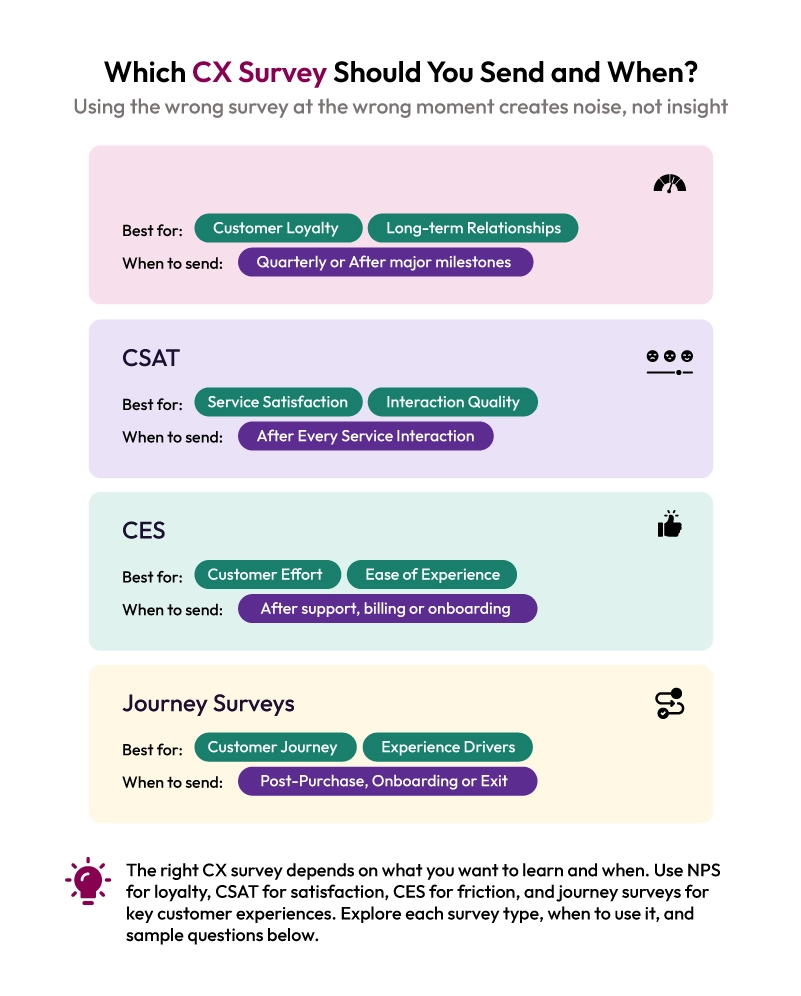
Net Promoter Score (NPS)
- What it is: A loyalty-focused survey that asks customers how likely they are to recommend you.
- Goal: Measure customer loyalty and likelihood to promote the brand.
- Measures: NPS score (Promoters, Passives, Detractors), reasons behind ratings.
- Why it’s important: Strong predictor of growth and word-of-mouth influence.
- Sample Questions:
- On a scale of 0–10, how likely are you to recommend us to a friend or colleague?
- What is the main reason for your score?
- What could we do to improve your experience with us?
Customer Satisfaction (CSAT)
- What it is: A quick feedback tool asking customers how satisfied they are.
- Goal: Gauge short-term customer satisfaction with a recent experience.
- Measures: Satisfaction level (usually via rating scale).
- Why it’s important: Indicates how well specific experiences meet expectations.
- Sample Questions:
- How satisfied are you with your recent interaction/purchase?
- Did our product/service meet your expectations?
- How would you rate your overall experience with us?
Customer Effort Score (CES)
- What it is: A survey that measures the ease of completing a task or solving an issue.
- Goal: Reduce customer friction by identifying high-effort interactions.
- Measures: Perceived ease or difficulty of the experience.
- Why it’s important: Lower effort = higher retention and satisfaction.
- Sample Questions:
- How easy was it to resolve your issue or complete your task with us today?
- To what extent do you agree: “The process required minimal effort on my part”?
- What part of the experience felt most difficult?
Brand Perception Survey
- What it is: A survey that assesses how customers perceive your brand overall.
- Goal: Understand brand image, personality, and positioning.
- Measures: Brand traits, recall, trust, favourability.
- Why it’s important: Informs marketing, brand strategy, and reputation management.
- Sample Questions:
- How would you describe our brand in one word?
- What qualities do you associate with our brand?
- How does our brand compare to competitors in your mind?
Loyalty/Retention Survey
- What it is: A survey designed to measure the likelihood of a customer staying.
- Goal: Understand drivers of loyalty and reasons for potential churn.
- Measures: Retention risk, renewal intent, commitment drivers.
- Why it’s important: Retaining customers is more cost-effective than acquiring new ones.
- Sample Questions:
- How likely are you to continue using our product/service over the next 12 months?
- What keeps you coming back to us?
- Have you considered switching to a competitor? Why or why not?
Voice of the Customer (VoC) Survey
- What it is: A broad survey capturing customer opinions and suggestions.
- Goal: Hear directly from customers about their needs and experiences.
- Measures: Preferences, pain points, suggestions.
- Why it’s important: Enables customer-led innovation and prioritisation.
- Sample Questions:
- What do you value most about your experience with our company?
- Are there any pain points or frustrations you’ve experienced with us?
- How can we improve your overall experience?
Product/Service Feedback Survey
- What it is: Collects detailed customer feedback on specific offerings.
- Goal: Understand customer satisfaction with products/services.
- Measures: Performance, usefulness, feature gaps.
- Why it’s important: Guides product development and prioritisation.
- Sample Questions:
- How well does the product/service meet your needs?
- What features or functions do you find most valuable?
- Is there anything missing that you wish it had?
Customer Needs Assessment Survey
- What it is: A diagnostic survey to uncover customer challenges and priorities.
- Goal: Identify current and future customer needs.
- Measures: Customer goals, priorities, and pain points.
- Why it’s important: Informs product roadmaps and service strategies.
- Sample Questions:
- What challenges are you currently trying to solve?
- What factors are most important to you when choosing a solution?
- Are there any services or features we don’t offer that you wish we did?
Lifecycle & Journey Stage Surveys
These surveys are timed to specific stages in the customer lifecycle—from onboarding to renewal or exit. They aim to understand how experiences evolve across time, helping businesses adapt their approach to meet changing customer needs and reduce churn throughout the journey.
Onboarding Experience Survey
- What it is: A survey conducted after a new customer completes onboarding.
- Goal: Evaluate how effective and helpful the onboarding process was.
- Measures: Clarity of guidance, confidence using the product, initial satisfaction.
- Why it’s important: Strong onboarding boosts product adoption and reduces churn.
- Sample Questions:
- How would you rate your onboarding experience with us so far?
- Did you feel adequately supported during the onboarding process?
- What could we have done to make onboarding smoother?
Renewal/Contract Feedback Survey
- What it is: A feedback request sent before or after a subscription or contract renewal.
- Goal: Discover what influences renewal decisions.
- Measures: Satisfaction, renewal drivers, concerns.
- Why it’s important: Reveals how to increase retention and prevent churn.
- Sample Questions:
- What influenced your decision to renew (or not renew) your contract?
- Were your expectations met during the current term?
- What improvements would encourage you to stay with us longer?
Exit/Churn Survey
- What it is: A survey for customers who are leaving or have cancelled service.
- Goal: Understand why customers leave.
- Measures: Churn drivers, dissatisfaction points, likelihood of return.
- Why it’s important: Provides valuable insights to reduce future customer loss.
- Sample Questions:
- What is the primary reason you decided to leave?
- Is there anything we could have done differently to retain you?
- Would you consider returning in the future? Why or why not?
Customer Lifecycle Survey
- What it is: A periodic survey aligned to the customer’s stage in their journey.
- Goal: Track evolving needs and satisfaction over time
- Measures: Experience across lifecycle phases.
- Why it’s important: Tailors experience improvements based on stage-specific feedback.
- Sample Questions:
- How has your experience with us changed over time?
- Which stage of your journey has been most positive? Least positive?
- What could we do now to better support your needs?
Reactivation Feedback Survey
- What it is: A survey for past customers who are invited or persuaded to return.
- Goal: Discover why they left and what might bring them back.
- Measures: Past dissatisfaction, current appeal, switching behaviour.
- Why it’s important: Helps design more effective win-back campaigns.
- Sample Questions:
- What made you stop using our product/service?
- What would encourage you to come back?
- How does your current provider compare to us?
Subscription Experience Survey
- What it is: Feedback from current subscribers about their experience.
- Goal: Assess satisfaction with subscription plans and value.
- Measures: Plan usage, perceived value, upgrade/downgrade intent.
- Why it’s important: Helps refine pricing, packaging, and retention strategies.
- Sample Questions:
- Are you satisfied with your current subscription plan?
- Do you feel you’re getting good value for your money?
- Would you be interested in upgrading, downgrading, or customising your plan?
Testing, Innovation, and Improvement Surveys
These surveys support continuous improvement by focusing on product development, innovation, and performance benchmarking. They involve customers and employees in refining services and identifying new opportunities. These insights are crucial for staying competitive and responsive to market shifts.
Feature Usability Survey
- What it is: A focused survey on how customers interact with a specific feature.
- Goal: Evaluate ease of use and effectiveness of a new or existing feature.
- Measures: Usability, satisfaction, suggestions for improvement.
- Why it’s important: Provides direct insights to improve feature design and functionality.
- Sample Questions:
- How easy was it to use [Feature Name]?
- Did this feature help you achieve your goal?
- What suggestions do you have to improve this feature?
Beta Feedback Survey
- What it is: A feedback tool for customers testing a beta version of a product or service.
- Goal: Identify bugs, gather first impressions, and validate new concepts.
- Measures: Initial satisfaction, usability, feature relevance.
- Why it’s important: Reduces risk before full-scale launch and fosters user involvement.
- Sample Questions:
- What was your first impression of the beta version?
- Did you encounter any bugs or issues while testing?
- How would you rate the overall usefulness of the new feature?
Customer Experience Benchmarking Survey
- What it is: A comparative survey assessing customer experience against industry norms.
- Goal: Understand how your CX stacks up against competitors.
- Measures: Satisfaction, perceived quality, competitive differentiation.
- Why it’s important: Identifies CX gaps and competitive advantages.
- Sample Questions:
- How would you rate your experience with us compared to similar companies?
- What do we do better than others you’ve used?
- In which areas do you think we fall behind?
Survey on Omnichannel Experience
- What it is: A survey exploring customer perceptions across multiple touchpoints.
- Goal: Ensure consistency and integration across all customer-facing channels.
- Measures: Channel consistency, preferred channels, friction points.
- Why it’s important: Helps unify brand experience and reduce drop-offs across channels.
- Sample Questions:
- Have you used more than one channel (e.g. app, phone, website) to interact with us?
- Was your experience consistent across all channels?
- Which channel do you prefer, and why?
Customer Co-Creation/Innovation Survey
- What it is: A participatory survey that invites customers to help shape future offerings.
- Goal: Gather innovative ideas and validate future product concepts.
- Measures: Willingness to participate, ideation quality, alignment with customer needs.
- Why it’s important: Builds engagement and reduces the risk of building unwanted features.
- Sample Questions:
- Would you be interested in helping us shape new features or services?
- What ideas do you have for improving our product/service?
- What unmet needs should we consider in future offerings?
Employee-Driven CX Survey
- What it is: An internal survey for frontline employees to share customer insights.
- Goal: Capture real-time CX feedback from the people closest to the customer.
- Measures: Recurring customer issues, internal pain points, improvement ideas.
- Why it’s important: Empowers employees and surfaces actionable insights that customers might not directly report.
- Sample Questions:
- What feedback do you regularly hear from customers?
- What customer pain points do you think we overlook?
- What improvements would help you deliver better CX?
Key Takeaways
Whether you’re running a retail store, managing a SaaS platform, or leading customer support at an enterprise, the ability to ask the right survey questions at the right moment is what separates good experiences from great ones. These 30 types of customer experience surveys offer a blueprint for building a truly responsive and insight-led CX strategy.
By aligning surveys to specific interactions, relationships, journey stages, and innovation cycles, your organisation can uncover hidden friction points, measure what matters most, and act on feedback in real time. Start small, stay consistent, and use these insights to drive continuous improvement.
Because in the world of modern CX, listening well isn’t just a nice-to-have—it’s a competitive advantage.
Run an AI-powered CX program beyond surveys
See our platform in action. A live demo tailored to your organization’s needs.








Alvier Marqueses
More Articles
-
- Blog

Employee Experience Software in 2026: 8 Platforms Across the Modern EX Stack
Choosing employee experience software is not as simple as comparing survey features. The category now spans employee listening, digital workplace tools, performance systems, recognition platforms, communication technology and enterprise experience-management… -
- Blog
8 Best Employee Feedback Platforms in 2026 for Different Feedback Needs
This guide compares eight platforms across different employee feedback needs, including continuous listening, qualitative analysis, manager feedback, enterprise EX, employee engagement and flexible surveys. -
- Blog
7 Customer Insights Platforms to Consider in 2026
Which customer insights platform can turn surveys, conversations, behavioral data and customer feedback into information your teams can actually use? The answer depends on what you mean by customer insight.



Resonate CX Resources

The Definitive Guide to Choosing the Right CXM Software
Choosing the right CXM software takes strategy, requiring you to define goals, assess integrations, and select a long-term partner.
Why Invest in a CX Platform: A Strategic Move for Competitive Advantage
Discover why a CX platform drives better experiences, loyalty, and sustainable growth.
Should You Invest in a Customer Experience Management Platform?
This guide walks through the five factors that determine whether now is the right time to invest.
How to Prove the ROI on CX to Your Board
Learn to prove ROI of Customer Experience by turning sentiment into revenue, retention, and risk insights.
4 Critical Signs You Need a New CXM Platform Solution
Is your CX platform holding you back? Data silos, stagnant metrics, slow insights, and poor integration signal it’s time to upgrade.
NPS Software Buyer’s Checklist: 47 Questions to Ask Vendors
NPS software helps you choose smarter with 47 key questions for better insights, workflows, and impact.
How to Combine NPS and Voice of Customer for a Complete CX Measurement System
Discover how NPS and VoC connect to turn feedback into loyalty and growth.
How Long Does CX Implementation Take? Timeline and Success Indicators
CX implementation timeline? Learn more about honest expectations and proven framework to accelerates success.