TLDR:
- Ask specific, neutral, behavior-based questions.
- Keep each survey focused and include space for comments.
- Collect feedback at important journey moments, not only once a year.
- Treat exit feedback as a learning opportunity without forcing a fixed deadline.
- Give important feedback an owner, next step, and follow-up.
- Multi-location networks need consistent questions, benchmarking, and role-based reporting.
- Text Analytics and risk monitoring can help leaders manage feedback at scale.
Most childcare centers already ask parents for feedback. The harder part is getting answers that are honest, specific, and useful enough to improve the family experience.
A yearly survey may show broad satisfaction, but not why one room scores lower, where onboarding creates friction, or what needs attention before a family leaves.
Strong parent feedback best practices involve asking clearer questions, listening at meaningful moments, assigning ownership, and showing families what changed. The goal is not to achieve perfect scores. It is to build a reliable view of the family experience that helps leaders make better decisions across every center.
This article explains how childcare providers can design better surveys, choose the right listening moments, turn parent feedback into owned action, and manage insights consistently across multiple centers.
Customer Experience Case Studies
Real Brands. Measurable Results.
Discover how leading brands improved customer experiences, drove measurable growth, and turned feedback into actionable results.
Real organisations. Real outcomes. Act in real time.
Why Parents May Not Share Their Real Concerns
Childcare is a high-trust relationship. Parents depend on the same educators every day, so some may hesitate to criticize the service directly. They may fear tension, question whether an issue is serious enough, or give a positive overall rating despite frustration.
This does not mean parents are being dishonest. It means the feedback process must make honesty feel safe.
Explain why feedback is requested, how it will be used, and whether confidential options are available. A simple introduction can help: “We use your feedback to improve the experience for children and families. Please tell us what is working and where we can do better.”
Ask Specific and Neutral Questions
Clear questions produce clearer answers. Avoid leading language, double negatives, and statements that combine several ideas.
Instead of asking, “Are you happy with our excellent communication?” ask, “I receive timely information when something important affects my child.”
Instead of relying only on “How satisfied are you with the center?” add questions such as:
- “My child’s educators understand their routines and preferences.”
- “I feel comfortable raising a concern with the center team.”
- “Billing and booking information is easy to understand.”
- “My family feels welcomed and included.”
These observable questions give leaders a clearer area to investigate. Negative wording is unnecessary. “I was not left uninformed” can confuse respondents; neutral wording is easier to answer and interpret.
Keep Each Survey Focused
There is no universal perfect survey length. A check-in after a tour may need only a few questions. A broader relationship survey may cover child well-being, communication, educator relationships, operations, and belonging.
Match the length to the purpose and remove questions the team will not review or use. Include an open-text question, such as “What is one thing we could improve?” Comments can explain a score and reveal issues outside the predefined topics.
Collect Feedback at Important Journey Moments
An annual survey provides one snapshot. Family expectations and concerns can change during onboarding, room transitions, ongoing care, or renewal.
Possible listening moments include after a tour, during the first weeks of enrollment, around a room transition, after resolving a concern, before re-enrollment, and at exit. These are examples, not fixed rules.
TheirCare, an Australian outside-school-hours care provider, introduced 30-day and 90-day onboarding surveys after finding that longer-term relationship surveys missed early settling-in challenges. That timing worked for its journey; another provider may need different checkpoints.
Choose moments when the experience is still clear and the team can respond usefully.
Make Exit Feedback Easier to Share
Families who leave may explain concerns they did not raise while enrolled. Exit feedback can reveal issues that relationship surveys miss, but it should not feel like an interrogation or an attempt to challenge the decision.
Ask while the experience is still fresh, without treating a strict 48-hour window as a universal rule. Keep the survey short and respectful. Useful questions include:
- What was the main reason for leaving?
- Was there anything we could have handled differently?
- What worked well during your time with us?
- Would you consider returning or recommending the center?
Turn Parent Feedback Into Visible Improvement
Feedback loses value when it remains in a report. A practical response process is to review the feedback, identify what needs action, assign an owner, contact the family privately where appropriate, share broader improvements, and check whether the change helped.
For example: “You told us that room-transition information was arriving too late. We now provide a transition guide and introduce families to the new educators before the move.”
This shows parents their time was respected and can support future participation.
Use feedback with educators as a development tool, not a public scorecard. “Parents would value more detail in daily updates” creates a better conversation than “Your communication score is below average.” Before judging performance, leaders should consider training, workload, systems, staffing, and expectations.
Managing Feedback Across Multiple Centers
A single center can often review comments directly, discuss themes in team meetings, and follow up personally.
A multi-location network needs consistency without removing local judgment. Leaders need comparable questions, center-level access, fair location comparisons, shared escalation rules, action tracking, and visibility of network-wide themes.
TheirCare used role-specific dashboards to give area managers and operational teams location-level visibility into NPS and service performance. The case study also describes weekly reviews and regular team discussions, helping move CX from occasional reporting into operations.
How to Choose the Right CX Platform for Childcare
A basic survey tool may be enough for occasional feedback at one center. A growing network usually needs more structure.
Look for:
- Feedback across the parent journey
- NPS, satisfaction, effort, and custom questions
- Open-text analysis
- Center-level and network-level reporting
- Role-based access
- Alerts and owned actions
- Original comments behind summaries
- Benchmarking with clear comparison groups
- Privacy and permission controls
- Follow-up measurement
The platform should help leaders move from “What is the score?” to “Why did it change, who needs to respond, and did the response work?” Benchmarking should support fair peer comparisons and show where strong practices can be repeated.
Childcare and Before & After School Care Customer Experience Opportunities 2026 | USA
Why Resonate CX Is Built for the Childcare Industry
Resonate CX combines feedback collection, analysis, reporting, benchmarking, and action workflows for childcare and education providers.
Text Analytics processes unstructured feedback and identifies themes, sentiment, emotions, and emerging patterns. This reduces manual review and helps teams understand the customer comments driving emerging themes.
Risk Radar surfaces operational, compliance, and legal risk signals in feedback. Teams can review source comments, assign owners, add notes, and track mitigation. It should not be described as automatically predicting which individual family will leave.
Role-based reporting helps executives, area managers, and center leaders see information suited to their responsibilities. Resonate CX’s education solution also includes action queues for tracking parent responses, assigning responsibility, and moving issues from pending to completed.
Together, these capabilities replace scattered results with a consistent process for understanding and acting on family feedback.
Parent Feedback Best Practices at a Glance
| Practice | Why it matters |
| Ask specific, neutral questions | Gives teams a clear area to investigate |
| Keep surveys focused | Reduces effort and supports useful responses |
| Include open-text feedback | Captures issues outside predefined questions |
| Listen at journey moments | Finds concerns while action is possible |
| Make exit feedback simple | Reveals reasons families may not have shared |
| Assign clear ownership | Keeps feedback from remaining in reports |
| Show families what changed | Builds trust in the process |
| Use network-level reporting | Creates consistency across locations |
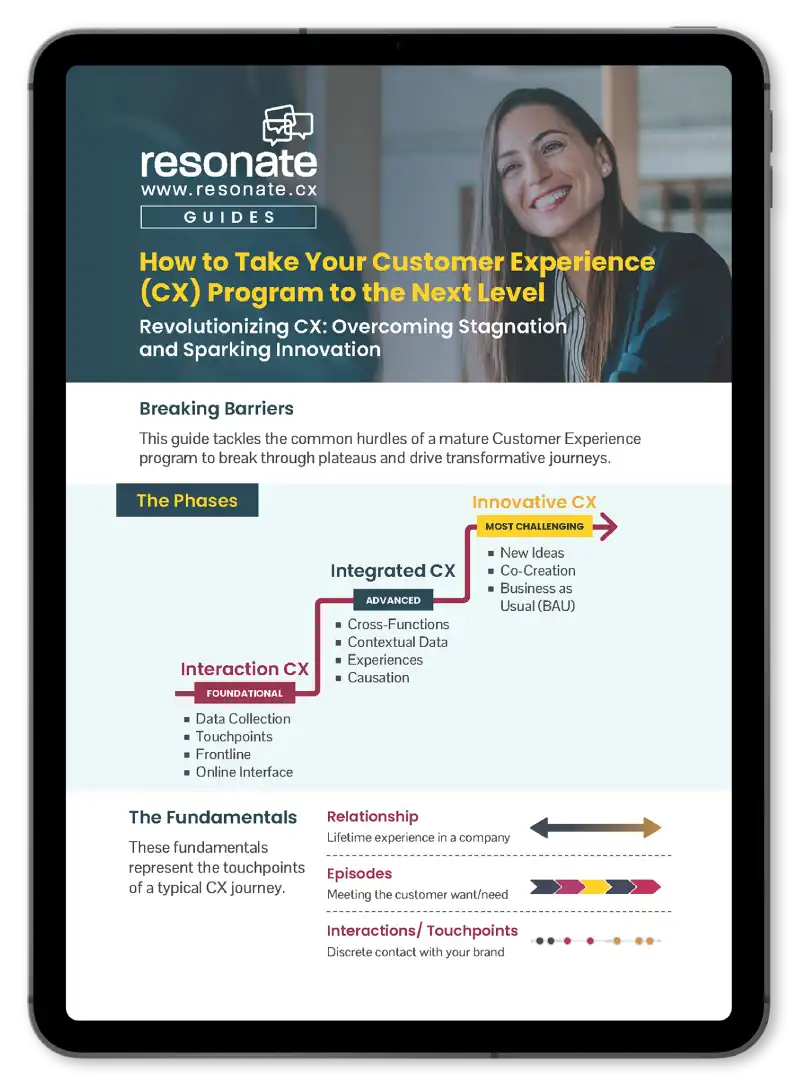
How to Take Your CX to the Next Level
In this guide, you’ll learn:
Frequently Asked Questions
What are the most useful parent feedback questions?
Ask about child well-being, communication, educator relationships, operational ease, and belonging. Include an open-text question for other concerns.
How often should childcare centers ask for feedback?
Combine relationship surveys with check-ins during onboarding, room transitions, concern resolution, and exit. Match timing to the family journey and your ability to respond.
Should surveys use negatively worded questions?
Use clear, neutral, behavior-based questions. Avoid wording that creates confusion or double negatives.
How long should a parent survey be?
Match length to purpose. A touchpoint survey may need a few questions; a relationship survey may need more. Remove unused questions.
How should negative feedback be shared with educators?
Share themes with context, frame them as development opportunities, and agree on a next step. Do not turn one comment into a public performance judgment.
What does a multi-center provider need that a single center may not?
A network needs consistent questions, role-based dashboards, fair comparisons, shared escalation rules, benchmarking, and cross-center visibility.
Translate Feedback Into Retention
Parent feedback creates value when it leads to visible, accountable improvement. When families see that concerns are understood, assigned to the right people, and used to improve the experience, trust can grow.
Resonate CX helps early education providers collect feedback, identify patterns across locations, compare performance, and turn findings into clear next steps.
See how Resonate CX can help your childcare network turn parent feedback into stronger family trust and long-term retention. Book a Demo today.
Run an AI-powered CX program beyond surveys
See our platform in action. A live demo tailored to your organization’s needs.








Jaby K J
More Articles
-
- Blog

What Is Voice of Customer (VoC)? A Guide to Turning Feedback Into Better Decisions
A customer can say checkout was frustrating. Analytics can show where they abandoned. Voice of Customer brings those signals together -
- Blog
Tenant Feedback Best Practices for Multi-Property Portfolios
Discover how coworking operators use VoC benchmark in improving member experience, reducing churn, and building communities that drive retention. -
- Blog
CSAT vs NPS: What Conflicting Scores Reveal About Customer Experience
What should a CX team do when CSAT is 92% but NPS is falling? Or when NPS remains strong while



Resonate CX Resources

The Definitive Guide to Choosing the Right CXM Software
Choosing the right CXM software takes strategy, requiring you to define goals, assess integrations, and select a long-term partner.
Why Invest in a CX Platform: A Strategic Move for Competitive Advantage
Discover why a CX platform drives better experiences, loyalty, and sustainable growth.
Should You Invest in a Customer Experience Management Platform?
This guide walks through the five factors that determine whether now is the right time to invest.
How to Prove the ROI on CX to Your Board
Learn to prove ROI of Customer Experience by turning sentiment into revenue, retention, and risk insights.
4 Critical Signs You Need a New CXM Platform Solution
Is your CX platform holding you back? Data silos, stagnant metrics, slow insights, and poor integration signal it’s time to upgrade.
NPS Software Buyer’s Checklist: 47 Questions to Ask Vendors
NPS software helps you choose smarter with 47 key questions for better insights, workflows, and impact.
How to Combine NPS and Voice of Customer for a Complete CX Measurement System
Discover how NPS and VoC connect to turn feedback into loyalty and growth.
How Long Does CX Implementation Take? Timeline and Success Indicators
CX implementation timeline? Learn more about honest expectations and proven framework to accelerates success.