TLDR:
- Customer Experience (CX) refers to a customer’s total perception of a brand, encompassing every interaction they have with it. This includes all touchpoints, from initial marketing to customer support and post-purchase follow-up.
- User Experience (UX) is more focused and tactical, specifically concerned with how a person interacts with a particular product, such as a website, app, or software. Its primary goal is to make that interaction as efficient and user-friendly as possible.
- CX has a broader scope, as it covers the entire customer journey and is owned by multiple departments like sales, marketing, and customer service. It is often measured using sentiment-based metrics like the Net Promoter Score (NPS).
- UX, on the other hand, is generally owned by product or design teams and is measured through behavioural metrics that track how users interact with a digital interface. These metrics include things like task success rate and error frequency.
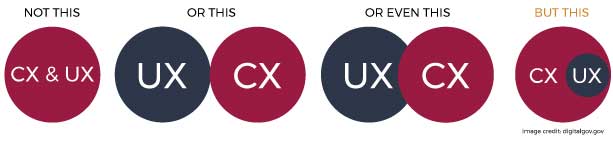
- Despite their differences, CX and UX are deeply interconnected and must be aligned for a business to succeed. A positive UX is a critical component of a great CX, and companies that integrate both strategies will create a more satisfying and cohesive experience for their customers.
As businesses race to meet rising customer expectations in a digital-first world, the terms Customer Experience (CX) and User Experience (UX) sometimes get thrown around with little regard for what they actually mean. Perhaps the differences aren’t so important when all you’re doing is driving home the importance of customers in a presentation deck. Even so, these two concepts are not interchangeable. What’s more, treating them as such can leave critical blind spots in your strategy.
Digging deeper, understanding the difference between CX and UX isn’t just a semantic exercise. It’s a way of guaranteeing that your smaller tactical decisions contribute to a bigger customer-focused strategy. When this happens, you’ll make fewer missteps in knowing your customers, improving outcomes across your business.
The potential gains may be more than you expect. According toresearch from PwC, buyers are willing to pay up to 16% more for a great experience with products and services. Surprisingly, 63% say they’d share more information if a business offers a good customer experience, something that has major implications not just for marketing, but for future product development and long-term customer loyalty.
To make the most of these opportunities, it’s essential to understand the distinct yet closely related roles these two concepts play. This article breaks down the biggest differences between customer experience and user experience, explores how and where they intersect, and why both deserve equal attention in an experience-driven world.
Quick Definitions – CX and UX Explained
Let’s start by clarifying the definitions of CX vs UX.
What Is Customer Experience (CX)?
Customer experience refers to the overall perception a person has of your brand at every touchpoint throughout the entire customer journey.
- Includes all touchpoints from marketing and sales to customer support and post-purchase interactions.
- Includes every online and offline channel.
- It’s holistic and strategic, looking at the wider, long-term implications of decisions on customer behaviours.
What Is User Experience (UX)?
User experience focuses on how a person interacts with a specific product, app, or digital interface:
- Covers specific areas of usability, design, responsiveness, intuitiveness, accessibility, and task efficiency.
- UX is tactical and task-oriented. Most often, it zeroes in on how easy or enjoyable it is to complete a specific action.
- UX is just one component of the customer journey, the part that involves direct interactions with the technology.
Key Differences Between CX and UX
Although customer experience and user experience often overlap, they diverge in several important ways.
| Customer Experience (CX) | User Experience (UX) | |
| Scope | Encompasses every online and offline interaction a customer has with the brand | Focuses on specific interactions, such as navigating an app or completing a checkout |
| Ownership | A cross-functional responsibility involving marketing, sales, operations, and customer support teams | Typically owned by product and design teams focusing on interface design and functionality |
| Measurement | Evaluated using sentiment-based tools like Net Promoter Score (NPS) and Customer Satisfaction (CSAT) | Measured with behavioural metrics such as task success rate, time on task, and error frequency |
| Touchpoints | Covers the full customer journey, from marketing emails to service recovery, and beyond | Focuses on interactions with specific products or interfaces (e.g., websites, apps, hardware) |
Taken together, we can see that while CX and UX optimisation serve different purposes, both are essential for delivering a complete and satisfying experience. Knowing the differences in the scope, owners, measurement systems, and touchpoints in customer vs user experience also helps ensure that each is addressed without unnecessary overlap or confusion.
How CX and UX Intersect and Work Together
While CX and UX operate at different levels, in practice, each of them affects the other. A common example is the customers’ reactions to website UX. A frictionless user experience makes customers feel at ease when they’re using a website, increasing the chances of more usage and loyalty, hallmarks of good CX. A bad UX, on the other hand, discourages any further use of a site, even if other aspects of CX like customer service are otherwise exemplary.
To avoid this disconnect, businesses should align all teams that work on CX and UX under a shared strategy. Collaboration across functions ensures that any improvements in the user journey also improve upon the customer journey, and vice versa.