London, United Kingdom, 2026 — Resonate CX hosted an exclusive executive event in London for leaders across the UK flexible workspace sector, presenting findings from its State of the Flexible Workspace 2026 report. The event brought together operators, investors, and workplace experience leaders for a data-led discussion on the forces shaping tenant demand, occupancy, and long-term retention in a market defined by uncertainty and rapid change.
Hosted by Resonate CX CEO Mita Bedi, the session covered the platform’s latest UK flex space research — a statistically significant study conducted with a 95% confidence level — examining how current and prospective tenants are using flexible workplaces, what experience factors drive their decision to stay or leave, and where the commercial opportunity lies for operators who can differentiate on experience.
The Market in 2026
Opening the session, Mita Bedi reflected on the conditions making this year’s research particularly relevant: geopolitical uncertainty, AI-driven disruption to workforce planning, evolving government policy on flexible working rights, and a continuing imbalance between supply and demand in the UK flex market. In a climate where long-term lease commitments feel increasingly difficult to justify, flexibility has become a structural advantage for the sector.
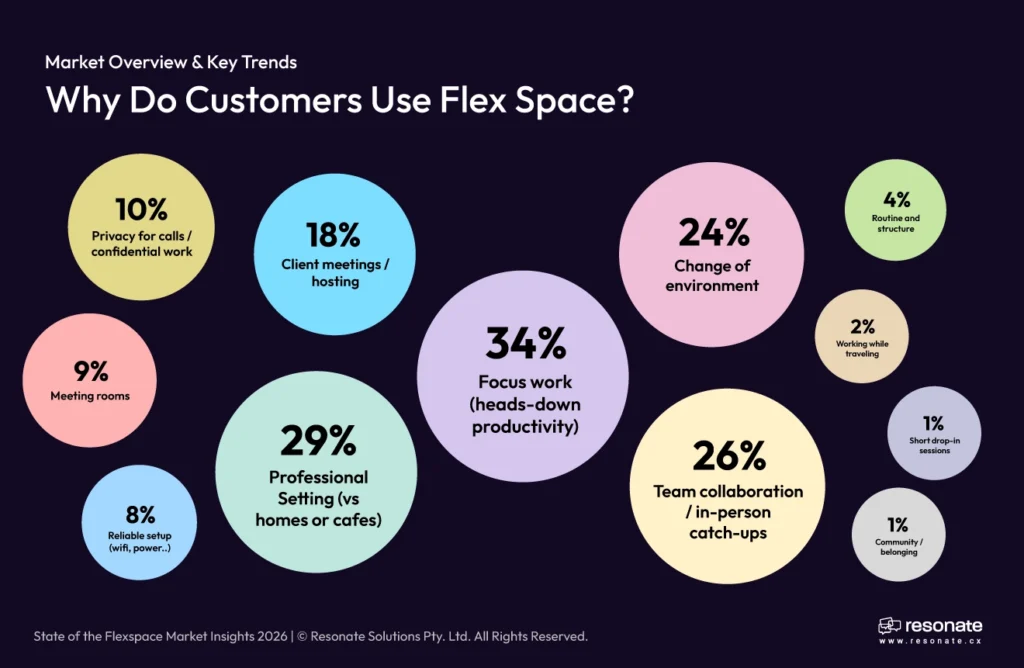
The 2026 data captures how tenant usage patterns have settled in the post-COVID environment. A clear divide has emerged between highly active users who depend on flex space for focus work and professional environment, and occasional users who represent a significant conversion opportunity for operators willing to design for their needs. The most commonly cited reasons tenants choose flex space include focused heads-down productivity (34%), the professional setting versus home or café environments (29%), and team collaboration and in-person catch-ups (26%).
The research also examines what drives churn — a central concern in a market where acquiring a new tenant is becoming progressively more expensive — and which amenities and loyalty programmes are most effective at increasing engagement and extending tenancy length.
Experience as a Commercial Differentiator
A recurring theme across the event’s discussions was that supply in the UK flex market exceeds demand, meaning only operators with a clearly differentiated product and experience proposition will sustain strong occupancy. The research provided a direct commercial framing for experience investment: if an existing tenant can be persuaded to add one day per week to their usage pattern, the revenue implication across a portfolio is significant — and experience is the primary lever available to flex operators to achieve it.
Attendees explored how the data maps to their own tenant base, where the gaps between current experience and the ideal flex space are largest, and which persona segments represent the highest-value growth opportunities within their existing membership.
A Data-Led Path Forward
For flex space operators navigating a market where flexibility is table stakes and experience is the differentiator, the State of the Flexible Workspace 2026 report provides a specific, evidence-based framework for understanding tenant expectations and acting on them.
The report is available to download now.
Run an AI-powered CX program beyond surveys
See our platform in action. A live demo tailored to your organization’s needs.








Aryne Monton
More Articles
-
- Blog

What Is Voice of Customer (VoC)? A Guide to Turning Feedback Into Better Decisions
A customer can say checkout was frustrating. Analytics can show where they abandoned. Voice of Customer brings those signals together -
- Blog
Tenant Feedback Best Practices for Multi-Property Portfolios
Discover how coworking operators use VoC benchmark in improving member experience, reducing churn, and building communities that drive retention. -
- Blog
CSAT vs NPS: What Conflicting Scores Reveal About Customer Experience
What should a CX team do when CSAT is 92% but NPS is falling? Or when NPS remains strong while



Resonate CX Resources

The Definitive Guide to Choosing the Right CXM Software
Choosing the right CXM software takes strategy, requiring you to define goals, assess integrations, and select a long-term partner.
Why Invest in a CX Platform: A Strategic Move for Competitive Advantage
Discover why a CX platform drives better experiences, loyalty, and sustainable growth.
Should You Invest in a Customer Experience Management Platform?
This guide walks through the five factors that determine whether now is the right time to invest.
How to Prove the ROI on CX to Your Board
Learn to prove ROI of Customer Experience by turning sentiment into revenue, retention, and risk insights.
4 Critical Signs You Need a New CXM Platform Solution
Is your CX platform holding you back? Data silos, stagnant metrics, slow insights, and poor integration signal it’s time to upgrade.
NPS Software Buyer’s Checklist: 47 Questions to Ask Vendors
NPS software helps you choose smarter with 47 key questions for better insights, workflows, and impact.
How to Combine NPS and Voice of Customer for a Complete CX Measurement System
Discover how NPS and VoC connect to turn feedback into loyalty and growth.
How Long Does CX Implementation Take? Timeline and Success Indicators
CX implementation timeline? Learn more about honest expectations and proven framework to accelerates success.