TLDR:
- Segment satisfaction results before relying on organization-wide averages.
- Check who was invited, who responded, and which customers may be missing.
- Choose NPS, CSAT, CES, or other measures according to the business question and program design.
- Use neutral questions tied to a specific experience or interaction.
- Analyze satisfaction scores alongside comments, journey information, and operational context.
- Keep sampling uncertainty separate from systematic bias.
- Use benchmarking for context rather than assuming it explains why performance changed.
- Give important findings clear ownership and measure how the experience changes after improvements are made.
A customer satisfaction score can look precise while hiding a weak measurement process.
The survey may have reached the wrong customers. The question may have been unclear. Timing may have changed. One strong-performing location may be masking problems elsewhere. Or a movement in the overall score may look important even though the underlying sample is too small or too different from the previous period.
Reliable customer satisfaction measurement requires more than calculating a score. Organizations need to understand who responded, what experience was measured, how the question was asked, which customer groups are affected, what the comments reveal, and what teams should investigate next.
Here are eight common customer satisfaction measurement mistakes and how to avoid them.
Customer Experience Case Studies
Real Brands. Measurable Results.
Discover how leading brands improved customer experiences, drove measurable growth, and turned feedback into actionable results.
Real organisations. Real outcomes. Act in real time.
Why Customer Satisfaction Measurement Goes Wrong
Customer satisfaction measurement often goes wrong before a dashboard is created.
Organizations may select a familiar metric, send a standard survey, and only afterward decide what the result is supposed to tell them.
A stronger measurement program starts with a defined business question.
For example:
- Are customers satisfied with onboarding?
- Is a particular service interaction creating unnecessary effort?
- Why is satisfaction lower in certain locations?
- Are complaints increasing after a process change?
- Which parts of the journey are contributing to declining experience signals?
Each question requires a suitable audience, timing, metric, context, and response path.
The important number is therefore not just the score itself. Decision-makers across CX, insights, service, operations, product, digital, and regional teams need to understand how the score was produced and what decision it should inform.
Mistake 1: Relying on Overall Customer Satisfaction Scores
An organization-wide average is useful for summarizing performance. It is rarely enough to diagnose what is happening.
Imagine an overall CSAT score of 78%.
That result could represent fairly consistent experiences across the business. Or it could combine excellent digital satisfaction with poor service satisfaction and significant problems in several regions.
The average alone cannot tell you which situation exists.
Break results down using relevant dimensions such as:
- Location or region
- Customer journey stage
- Product or service
- Channel
- Customer segment
- Customer tenure
- Interaction type
- Reporting period
Segmentation should be purposeful.
Creating dozens of slices after seeing the results can encourage teams to search until they find an interesting movement. Instead, identify the segments most relevant to the business question before analysis begins.
Always keep response counts visible as well. A dramatic movement in a group with eight responses should not automatically be interpreted in the same way as a similar movement supported by hundreds of comparable responses.
The better question is not:
“Did our satisfaction score increase?”
It is:
“Where did satisfaction change, for whom, and what evidence helps explain the movement?”
Mistake 2: Ignoring Survey Methodology and Response Bias
A satisfaction score becomes easier to trust when teams understand how the responses were collected.
Before comparing a score with another period, location, or customer group, examine:
- Who was eligible to receive the survey
- Who was actually invited
- Who responded
- Response rate
- Survey timing
- Collection channel
- Question wording
- Scale design
- Accessibility
- Language
- Any changes from earlier periods
The customers who answer a survey are not necessarily identical to those who do not.
People with particularly strong positive or negative experiences may respond differently from quieter customers. Digital-only collections can underrepresent people who do not use that channel. Changes to timing can also alter what customers are evaluating.
This is why a larger number of responses does not automatically remove every measurement problem.
If the survey method changed, document the change.
Do not present two materially different collection methods as a seamless historical trend without acknowledging the limitation.
Methodology gives the score credibility. Without it, a precise-looking number can create more certainty than the evidence supports.
Mistake 3: Using the Wrong Customer Satisfaction Metric
NPS, CSAT, and CES measure different aspects of customer experience, but organizations may use them differently depending on program design, industry, journey structure, and business objectives.
A practical starting point is:
| Metric | What It Measures | Commonly Used For |
| NPS | Likelihood to recommend | Broader relationship, advocacy, or loyalty tracking |
| CSAT | Satisfaction with an experience | Transactions, services, interactions, or journey stages |
| CES | Perceived effort | Tasks, processes, service interactions, or problem resolution |
These are common applications rather than rigid rules.
What matters is whether the metric matches the question the organization is trying to answer.
NPS should not automatically be interpreted as retention or financial value.
CSAT tells teams how satisfied customers report being, but the score alone does not explain why.
CES can help teams understand effort, but it still needs context around the interaction being measured.
Timing matters too.
A delivery satisfaction question sent before the order arrives measures something different from a survey sent after delivery.
A resolution survey sent while the customer’s issue remains open can capture an unfinished experience.
Define the experience first. Then choose the measure.
Mistake 4: Asking Too Many or Poorly Designed Survey Questions
Every additional survey question asks the customer to spend more time helping the organization.
That effort should produce information someone intends to use.
Survey questions should be specific, neutral, and tied to a particular experience or interaction.
Instead of:
How poor was our communication?
ask:
How clear was the information you received about your delivery?
The second question identifies what is being evaluated without steering the customer toward a negative response.
Before adding a question, ask:
- What business question does this answer?
- Who will use the result?
- Can the customer reasonably answer it?
- Is this information already available somewhere else?
- What happens if the score is low?
Avoid questions that ask customers to rate multiple things at once.
For example:
How satisfied were you with the speed and helpfulness of our support?
A customer may think the response was fast but unhelpful. One answer cannot show which part drove the rating.
Keep surveys proportionate to the journey moment and use open text when teams need customers to explain the reason behind a score.
Mistake 5: Measuring Customer Satisfaction Without Context
Satisfaction scores show direction.
Customer comments and operational information help teams investigate what might be behind that direction.
Suppose onboarding CSAT declines.
Possible explanations might include:
- Confusing instructions
- A technical problem
- Delayed communications
- Increased waiting times
- One struggling customer segment
- A problem concentrated in certain locations
Open-text feedback may suggest which explanation deserves investigation.
Operational information can then help teams test those possibilities.
That might include completion rates, service contacts, waiting times, error rates, cancellations, or journey events.
Text Analytics can also help teams organize large volumes of customer comments into recurring themes and sentiment. Resonate CX’s Text Analytics capability is designed to structure unstructured feedback and identify topics and sentiment patterns.
Technology should support investigation rather than eliminate judgment.
One unusually vivid customer comment should not automatically be treated as representative of the whole customer base.
Consider:
frequency + severity + affected customers + trend + operational context + risk
A rare issue involving safety, legal, compliance, or significant customer harm may still deserve faster attention than a far more frequent inconvenience.
Mistake 6: Relying on Sample Size Alone
Sample size matters because small samples usually create greater statistical uncertainty.
But sample size is not the same thing as overall measurement quality.
Teams should distinguish between two different problems:
Sampling uncertainty relates to random variation that arises because only part of the customer population has been measured.
Systematic bias occurs when the measurement process consistently underrepresents, excludes, or influences certain customers or responses.
Increasing sample size can reduce random sampling uncertainty.
It does not automatically correct:
- Poor question wording
- Coverage gaps
- Nonresponse bias
- Channel bias
- Inappropriate timing
- Unrepresentative customer groups
When reporting satisfaction results, provide enough information for decision-makers to interpret the score responsibly.
That can include:
- Number invited
- Number responding
- Response rate where useful
- Segment size
- Collection dates
- Channels
- Question wording
- Scale
- Known limitations
Avoid relying on universal sample-size rules.
The amount of evidence required should depend on factors such as population size, research method, level of precision required, and how consequential the decision will be.
Mistake 7: Using Customer Satisfaction Benchmarks Without Context
Benchmarks answer an important question:
How does our performance compare with a relevant reference group?
They do not automatically answer:
Why is our performance different?
Before comparing satisfaction scores externally, confirm whether the measures are reasonably comparable across:
- Metric
- Question wording
- Scale
- Customer population
- Industry
- Geography
- Channel
- Journey stage
- Collection period
An organization can improve significantly while its wider industry improves faster.
A stable score may also be meaningful during a period when comparable organizations are declining.
That is why benchmarking works best alongside:
- Internal historical trends
- Customer comments
- Journey information
- Operational measures
- Segment-level results
- Business context
Benchmarking provides context, not causation.
Resonate CX provides real-time CX Benchmarking against relevant market or industry performance, though availability varies across supported industries and geographies.
Buyers should therefore confirm that suitable benchmarks exist for their sector, geography, and program before making benchmarking a major evaluation requirement.
Mistake 8: Measuring Customer Satisfaction Without Clear Ownership
Customer satisfaction measurement creates little value when important findings have nowhere to go.
A dashboard can identify declining satisfaction.
It cannot decide which team should investigate the issue, remove an operational barrier, change a policy, improve a product, or contact a customer.
A practical process might include:
- Identify the priority signal.
- Assess urgency, severity, and risk.
- Assign an accountable owner.
- Investigate possible contributing factors.
- Agree on the response or improvement.
- Communicate with customers where appropriate.
- Measure how the experience changes after improvements are made.
Feedback may point toward a possible root cause, but teams should avoid assuming that customer comments alone prove why the problem occurred.
For example, repeated complaints about slow service may relate to staffing, unclear processes, system limitations, demand spikes, or several factors together.
Ownership should therefore sit with the people capable of investigating and influencing the issue, rather than automatically with the department that received the feedback.
Completing an assigned task is also not proof that customer satisfaction improved.
The organization still needs to observe what happens afterward.
Customer Satisfaction Measurement Mistakes at a Glance
| Mistake | What Can Go Wrong |
| Relying on overall averages | Important segment differences remain hidden |
| Ignoring survey methodology | Bias and collection changes are overlooked |
| Choosing the wrong metric | The score does not answer the intended question |
| Poor survey design | Customer effort increases without useful evidence |
| Measuring without context | Teams see movement but cannot investigate why |
| Focusing only on sample size | Systematic bias remains hidden |
| Misusing benchmarks | Comparison replaces investigation |
| Measuring without ownership | Customer signals never become improvement |
Childcare and Before & After School Care Customer Experience Opportunities 2026 | USA
What to Look for in a Customer Feedback or CX Platform
A customer feedback or CX platform should support reliable measurement and help teams use what they learn.
Organizations evaluating a platform should consider whether it supports:
- Journey-based feedback collection
- NPS, CSAT, CES, and relevant custom measures
- Open-text feedback
- Text and sentiment analysis
- Segmentation by location, journey, product, channel, and customer group
- Multi-location visibility
- Role-based dashboards and permissions
- Alerts
- Prioritized workflows
- Ownership and escalation
- Benchmarking where supported
- CRM, service, transactional, and operational integrations
- Before-and-after trend reporting
- Appropriate governance and human review
Use the organization’s own data during evaluation.
Give vendors anonymized customer comments, real location structures, user roles, journeys, and edge cases.
Where AI-generated findings may influence decisions, traceability should be treated as a buyer-evaluation requirement.
Ask how important findings can be checked against relevant evidence.
Do not assume that every AI-generated summary or answer automatically provides identical source-level traceability.
How Resonate CX Supports Customer Satisfaction Measurement
Resonate CX combines customer feedback collection, AI-supported analysis, benchmarking, reporting, and workflows within its Customer Experience Management platform. Its CXM platform includes AI-powered theme and sentiment analysis, executive reporting, and tools designed to move feedback toward frontline teams.
AI-Powered Text Analytics helps teams interpret open-text feedback at scale by organizing unstructured customer language into themes and sentiment.
CX Benchmarking provides live comparison context across supported industries and geographies. Resonate CX provides live industry comparison, with benchmarking available across selected industries and geographies.
Resonate’s Customer Experience Management platform describes My Queues as providing prioritized action lists to the appropriate people, and its Latrobe Community Health Service case study shows the feature being used to assign and escalate feedback.
Automated Smart Alerts provide action based notifications.
Role-based access and reporting can then help distribute information according to responsibility rather than requiring every user to work from the same view. Resonate’s platform materials describe access based on user, role, and group, alongside role-specific dashboards.
Together, these capabilities can help organizations move from:
satisfaction signal → context → priority → owner → improvement → measurement
They do not remove the need for sound survey design, representative listening, governance, human judgment, or careful interpretation.
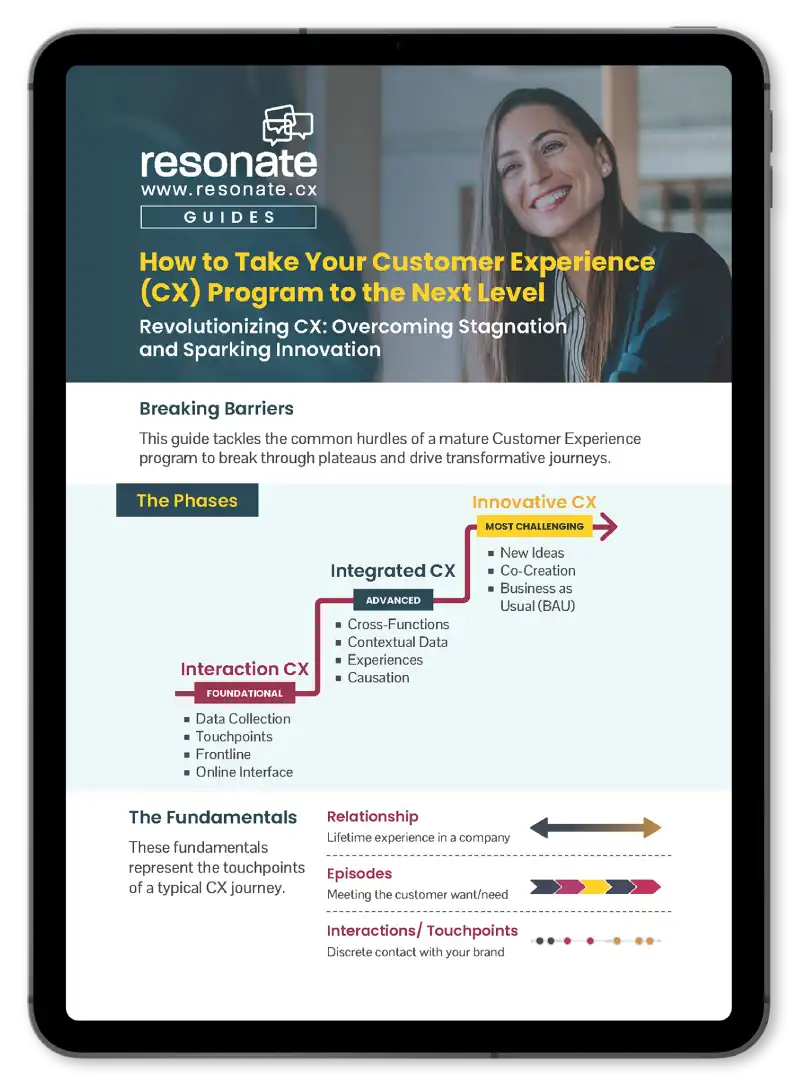
How to Take Your CX to the Next Level
In this guide, you’ll learn:
Frequently Asked Questions
What is the most common customer satisfaction measurement mistake?
One of the most common mistakes is treating an overall satisfaction score as a complete diagnosis. Organizations should also examine segments, response counts, survey methodology, customer comments, journey context, and operational information.
Which metric should organizations use to measure customer satisfaction?
The right metric depends on the business question and program design. CSAT is commonly used for satisfaction with particular interactions or experiences, CES for perceived effort, and NPS for broader recommendation or relationship measurement. These are common uses rather than strict rules.
Can a customer satisfaction survey contain too many questions?
Yes. Every additional question increases customer effort. Each question should support a defined decision, research objective, or operational need. Focused surveys are generally easier for customers to complete and teams to use.
Does a large sample guarantee reliable customer satisfaction results?
No. A large sample can reduce some forms of sampling uncertainty, but it does not automatically correct poor wording, nonresponse, coverage gaps, timing problems, or other systematic bias.
How can organizations tell whether customer satisfaction measurement is working?
Measurement is useful when teams understand how results were produced, can identify meaningful differences, assign important findings to appropriate owners, and track how relevant customer and operational measures change after improvements are implemented.
How to Improve Customer Satisfaction Measurement
Reliable customer satisfaction measurement starts with the process behind the score.
Define what experience you are measuring. Choose the customer group and timing carefully. Use an appropriate metric. Ask clear questions tied to a specific interaction. Keep the context around the response. Segment the results. Distinguish sampling uncertainty from bias. Use benchmarks for perspective rather than explanation.
Most importantly, make sure important findings have somewhere to go.
Customer satisfaction measurement becomes useful when organizations can move from “What is the score?” to “What is happening, where is it happening, who needs to investigate it, and what should we monitor next?”
Explore Resonate CX to see how Text Analytics, CX Benchmarking, and role-based workflows help teams understand satisfaction signals, identify priorities, and coordinate improvement.
Run an AI-powered CX program beyond surveys
See our platform in action. A live demo tailored to your organization’s needs.









Jaby K J
More Articles
-
- Blog

Customer Journey Mapping Process: 7 Steps to Build an Evidence-Based Journey Map
A customer journey map can look polished and still be wrong. Teams may agree on the stages and touchpoints while -
- Blog
5 Customer Experience Examples and the CX Lessons They Teach.
A useful customer experience example should show more than a good score or a successful survey program. It should show -
- Blog
Customer Journey Analytics: How to Identify Friction and Improve CX
Learn how customer journey analytics connects feedback, behavior, and operational data to identify friction and improve customer journeys.



Resonate CX Resources

The Definitive Guide to Choosing the Right CXM Software
Choosing the right CXM software takes strategy, requiring you to define goals, assess integrations, and select a long-term partner.
Why Invest in a CX Platform: A Strategic Move for Competitive Advantage
Discover why a CX platform drives better experiences, loyalty, and sustainable growth.
Should You Invest in a Customer Experience Management Platform?
This guide walks through the five factors that determine whether now is the right time to invest.
How to Prove the ROI on CX to Your Board
Learn to prove ROI of Customer Experience by turning sentiment into revenue, retention, and risk insights.
4 Critical Signs You Need a New CXM Platform Solution
Is your CX platform holding you back? Data silos, stagnant metrics, slow insights, and poor integration signal it’s time to upgrade.
NPS Software Buyer’s Checklist: 47 Questions to Ask Vendors
NPS software helps you choose smarter with 47 key questions for better insights, workflows, and impact.
How to Combine NPS and Voice of Customer for a Complete CX Measurement System
Discover how NPS and VoC connect to turn feedback into loyalty and growth.
How Long Does CX Implementation Take? Timeline and Success Indicators
CX implementation timeline? Learn more about honest expectations and proven framework to accelerates success.