TLDR:
- Customer Effort Score (CES) measures how hard a customer had to work to get their issue resolved or their goal achieved. Lower effort, higher loyalty.
- The CES v2.0 question: “How easy was it to resolve your issue today?” Answered on a 1–7 scale.
- CES is a stronger predictor of repurchase, share-of-wallet growth, and negative word-of-mouth than NPS or CSAT in service interactions.
- The big insight from the research: delighting customers doesn’t drive loyalty, adding effort destroys it.
- Most CX programs measure NPS quarterly and call it a day. They’re missing the metric that catches churn risk weeks earlier.
A 9-Hour Phone Call Is Not the Goal
In the most-told story in customer experience, a Zappos rep stayed on the phone with a customer for nine hours and thirty-seven minutes. Whole conferences have been built around it. Slide decks open with it.
It is also exactly the wrong story to build a CX program around.
The Customer Contact Council (now part of Gartner) ran the largest CX research project of its decade, 75,000 customers across hundreds of companies, to answer one question: what actually drives loyalty? The expected answer was delight. The actual answer was the opposite.
Customers who had effortless service experiences became loyal. Customers who had high-effort experiences became disloyal. And, this was the surprise, customers who had delightful experiences were no more loyal than customers who had merely competent ones. The whole “wow them” school of CX was built on a vibe, not a finding.
The metric that came out of that research is Customer Effort Score (CES). It is the most underused loyalty metric in the modern CX stack, and the one most likely to flag a churn risk before NPS does.
This guide is the operator’s view: what CES is, how to score it, when to use it instead of NPS, what the benchmarks look like, and how to design a program that actually moves the number.
CX Guides | free to download
No fluff. Just CX strategy guides for real-world use. Get tips from the experts.
What Is Customer Effort Score (CES)?
Customer Effort Score (CES) is a customer experience metric that measures how much effort a customer had to put in to get their issue resolved, their question answered, or their goal achieved. It is most often used immediately after a service interaction, support contact, or self-serve task.
The current standard version (CES v2.0) uses a single question:
“How easy was it to resolve your issue today?”
Customers answer on a 1–7 scale, where 1 is “very difficult” and 7 is “very easy.” The score is calculated as the percentage of respondents answering 5, 6, or 7, sometimes expressed as the average score across all responses.
Two important nuances worth knowing up front:
- The original CES (2010, Harvard Business Review) used an “agree/disagree” statement: “The company made it easy for me to handle my issue.” It was abandoned because it was harder for customers to interpret.
- CES v2.0 is what almost every modern program uses. If a vendor is selling you something different, ask why.
For broader context on where CES sits alongside other metrics, our ultimate guide to customer experience metrics maps the full landscape.
Why CES Predicts Loyalty Better Than NPS or CSAT
The CEB / Gartner research reached a finding that should be uncomfortable for any CX team that runs only NPS:
In a service context, CES is a stronger predictor of future loyalty behaviour than NPS or CSAT.
Specifically, customers who reported high effort (CES scores of 1–3) were:
- Four times more likely to become disloyal than customers who reported low effort
- More likely to stop buying in the next 12 months
- More likely to reduce share of wallet
- More likely to share negative word-of-mouth, telling friends, colleagues, and review sites
NPS still has its place, particularly for relationship-level health, which is why the different types of NPS matter and why an NPS management platform earns its keep at the program level. But for the transactional moments, the support ticket, the onboarding session, the self-serve checkout, CES is the more honest predictor.
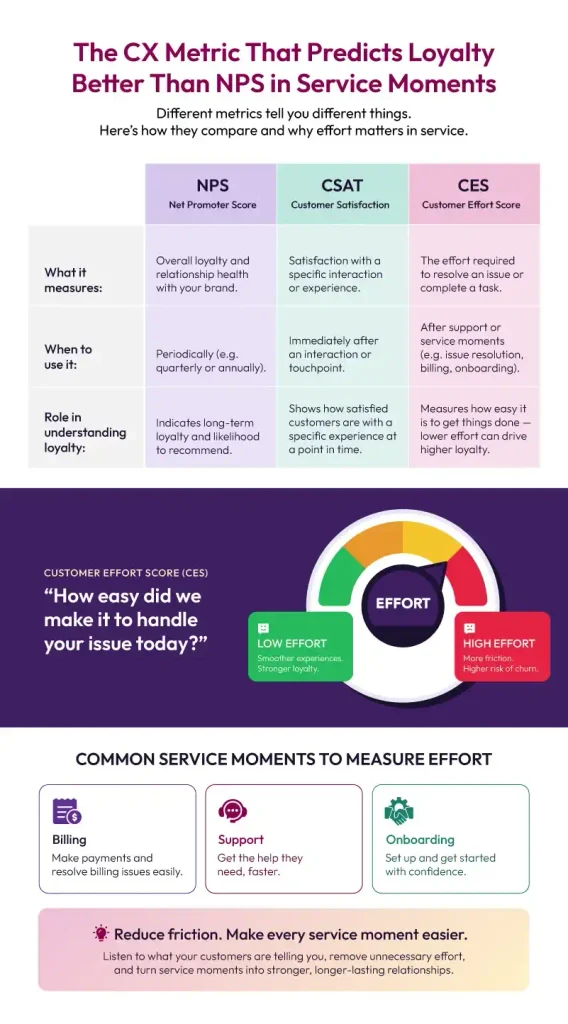
The simplest way to think about it: NPS asks would you recommend us? CSAT asks were you happy? CES asks did we waste your time? In the moments that decide whether a customer comes back, the third question is the one that matters most.
CES vs NPS vs CSAT: When to Use Which
|
Metric |
The question |
Best for |
Frequency |
What it predicts |
|
CES |
How easy was it to resolve your issue today? |
Specific service interactions, support tickets, self-serve flows |
Immediately post-interaction |
Future loyalty, churn risk, negative word-of-mouth |
|
NPS |
How likely are you to recommend us? |
Relationship-level health, brand-level loyalty |
Quarterly or bi-annual |
Long-term advocacy, referral revenue |
|
CSAT |
How satisfied were you with your experience? |
Transactional satisfaction snapshots, training feedback |
Post-event |
Short-term satisfaction signal |
The right answer is not pick one. It is pick the right combination. A robust customer feedback program layers all three: NPS for relationship, CSAT for satisfaction, CES for friction. Our piece on CSAT and NPS, what they are and when to use them is the companion read for the first two.
How to Calculate Customer Effort Score
Three calculation methods are in use. Pick one and stick with it.
Method 1: The Average Score (most common)
Sum every response (1–7) and divide by the number of respondents. Result: a single average score, typically reported to one decimal place.
Average CES = Sum of all CES responses ÷ Number of responses
A score of 5.5 or higher is generally considered healthy. Below 4.5 is a red flag.
Method 2: The Percentage of Top-Box Responses
Calculate the percentage of respondents who answered 5, 6, or 7 (i.e. agreed it was easy).
Top-box CES = (Number of responses 5–7 ÷ Total responses) × 100
A top-box score of 70% or higher is considered strong.
Method 3: The Net CES (less common)
Subtract the percentage of “high effort” responses (1–3) from the percentage of “low effort” responses (5–7).
Net CES = % Low Effort − % High Effort
Used when the team wants a single directional number, but harder to compare against industry benchmarks.
The most reliable comparison method is the average score on a 1–7 scale, because it matches how the original research was conducted and how most published benchmarks are reported.
CES Benchmarks by Industry
CES benchmarks vary significantly by industry, channel, and interaction type. Use the table below as a starting point, and adjust based on your own historical baseline.
|
Industry |
Healthy CES (avg, 1–7) |
Top-box % |
|
SaaS / Software |
5.4–6.0 |
70–80% |
|
Retail (in-store) |
5.6–6.2 |
75–85% |
|
Retail (online) |
5.2–5.8 |
65–75% |
|
Financial services |
4.8–5.4 |
60–70% |
|
Telecommunications |
4.4–5.0 |
50–60% |
|
Healthcare |
5.0–5.6 |
60–70% |
|
Hospitality |
5.6–6.2 |
75–85% |
The pattern is consistent: industries with high regulatory or operational complexity (telco, financial services) sit lower. Industries built on ease (hospitality, in-store retail) sit higher. If your CES is significantly below your industry band, the friction is probably visible to your customers, and to your competitors.
When to Send a CES Survey
CES is a transactional metric. Send it immediately after the moment that involved effort. Strong CES survey triggers include:
- After a support ticket is closed
- After a live chat or phone interaction ends
- After a customer completes onboarding
- After a self-service action (account update, return, password reset)
- After a renewal, billing change, or contract update
- After a key journey milestone, first value moment, integration go-live
The further from the interaction the survey is sent, the less reliable the score. The right moment is while the experience is still fresh, within minutes for digital, within 24 hours for human-handled interactions. Multi-channel feedback capture is the operating layer that makes this possible.
How to Run an Effective CES Program
A CES survey is easy to deploy. A CES program, one that actually moves the number, is harder. Five practices separate the programs that lift CES from the ones that just measure it.
1. Tie CES to a specific interaction, not a relationship
CES is not designed to measure your overall relationship with a customer. That’s NPS’s job. CES measures one moment. The survey wording, the timing, and the routing should all reference the specific interaction that just occurred. If you can’t name the moment, you shouldn’t be sending a CES survey for it.
2. Pair CES with an open-ended follow-up
A 4 on its own tells you nothing. A 4 with the comment “I had to call back three times to get the same answer” tells you everything. Resonate’s text analytics groups these comments by theme, the recurring friction patterns, without anyone having to read 500 of them by hand. The fundamentals are covered in our beginner’s guide to text analytics.
3. Route low scores to the people who can fix the friction
CES insight that lands in a dashboard nobody opens fixes nothing. The score has to land with the team that owns the moment, support, product, ops, success, within hours, not weeks. Closed-loop discipline is what separates programs that lift CES from programs that just track it. The closed-loop feedback model that empowers the frontline is the operating manual.
4. Look for the patterns, not the individual scores
A single 3 might be a bad day. A cluster of 3s on a specific journey step is a process problem. CES insight is most valuable in aggregate, by channel, by team, by product area, by customer segment. A modern voice of the customer management platform makes that pattern view native, instead of a quarterly slide.
5. Connect effort signals to behavioural signals
Score is one input. Behaviour is another. A high-effort score plus a drop in usage plus a delayed renewal is a churn risk you should be acting on this week, not catching at the next QBR. Risk Alert pulls the trigger early so the account owner can intervene before the relationship slips quietly.
How to Reduce Customer Effort
The CES research surfaced three categories of customer effort. Reduce any of them and the score moves.
Procedural effort
The literal steps a customer has to take. Number of clicks. Number of forms. Number of times they have to repeat themselves. Customers feel this acutely, and it’s the easiest category to fix because it’s measurable.
Cognitive effort
The thinking a customer has to do. Confusing language. Ambiguous next steps. Having to decide between three policy options to figure out which one applies. Cognitive effort hides in plain sight because it doesn’t show up in operational dashboards, only in customer comments.
Emotional effort
How the experience felt. Being made to repeat their problem to four different people. Being treated like a ticket number. Receiving a response that reads like it was written by legal. Roughly two-thirds of perceived effort is emotional rather than literal, which is why tone, language, and channel choice matter as much as process design.
A good place to start is our piece on how reducing friction in customer service boosts loyalty and lowers costs, friction reduction is the engine, CES is the gauge.
CES Across the Customer Journey
CES is not just a support metric. The smartest programs measure effort at every moment that decides loyalty:
- Onboarding effort, how easy was it to get to first value?
- Purchase / renewal effort, how easy was it to buy or renew?
- Resolution effort, how easy was it to get help?
- Self-serve effort, how easy was it to do this yourself?
- Account change effort, how easy was it to update, downgrade, cancel?
Each of these journey moments deserves its own CES sample. The customer journey guide is the map; CES is the dashboard at each turn.
For B2B specifically, where the relationship is longer and the buying group is larger, B2B customer experience covers how to layer CES across multiple stakeholders. And in service-heavy industries, the line between customer service and customer experience is precisely where CES does its sharpest work.
Where Resonate CX Fits
Most CX platforms can capture a CES score. Far fewer can turn that score into a fix.
Resonate CX was built for the second half of that equation. The platform consolidates the open-ended comments behind every CES score into the friction themes worth acting on in a single view. Process Flow routes high-effort interactions to the team that owns the moment, with clear ownership and SLA. Echo keeps the action visible to everyone touching that customer, so the loop actually closes. The full picture sits inside our broader customer experience management platform, feedback in, action out, friction down.
Common Mistakes to Avoid
The five most common ways CES programs underperform:
- Measuring CES at the relationship level. CES is for moments. NPS is for relationships. Mixing them muddies both.
- Sending the survey too late. A week after the interaction, the score is half memory and half noise.
- Asking too many questions. CES works because it’s one question. Bolt on five more and response rates collapse.
- Ignoring the verbatim. The score tells you what. The comment tells you why. Skip the comment, skip the action.
- No closing of the loop. A score collected and not acted on is worse than no score at all, it teaches customers their feedback doesn’t matter.
For a wider review of mistakes that cause programs to underdeliver, our piece on customer experience versus customer success shows how ownership confusion is often the underlying cause.
Key Takeaways
- CES measures effort, not satisfaction. And in service moments, effort is the better predictor of loyalty.
- Use the v2.0 question: “How easy was it to resolve your issue today?” on a 1–7 scale.
- Send it immediately, within minutes for digital, within 24 hours for human-handled interactions.
- Pair it with an open-ended follow-up so the score has the why attached.
- Close the loop fast. Insight without action makes the next survey worse.
- Use CES alongside NPS and CSAT, not instead of them.
Frequently Asked Questions
What is Customer Effort Score (CES)?
Customer Effort Score (CES) is a customer experience metric that measures how much effort a customer had to put in to get their issue resolved, their question answered, or their goal achieved. The standard CES v2.0 question is “How easy was it to resolve your issue today?” answered on a 1–7 scale.
How is CES calculated?
The most common method is the average score: sum every response on the 1–7 scale and divide by the number of respondents. Alternatively, calculate the percentage of respondents answering 5, 6, or 7 (the “top-box” method).
What is a good CES score?
A healthy average CES on the 1–7 scale is generally 5.5 or higher. A top-box CES of 70% or above is considered strong. Both vary by industry, telco and financial services typically run lower; hospitality and retail higher.
CES vs NPS, which is better?
Neither is better. They measure different things. CES is a stronger predictor of loyalty in transactional service moments. NPS is the right metric for relationship-level health and referral behaviour. Best programs use both.
When should I send a CES survey?
Immediately after the interaction. Within minutes for digital interactions, within 24 hours for human-handled ones. The further from the moment, the less reliable the score.
What scale does CES use?
CES v2.0 uses a 1–7 scale where 1 = “very difficult” and 7 = “very easy.” The original CES (2010) used a 1–5 agree/disagree scale, but it was retired because the wording confused respondents.
Does CES replace NPS?
No. CES measures effort in a specific interaction. NPS measures relationship-level loyalty. They are complementary, not substitutes. Most mature CX programs run all three of CES, NPS, and CSAT, each at its appropriate moment.
Can CES be used outside customer service?
Yes. CES is increasingly used across the entire customer journey, onboarding, self-serve, billing, renewal, account changes, wherever customer effort can predict downstream loyalty behaviour.
Run an AI-powered CX program beyond surveys
See our platform in action. A live demo tailored to your organization’s needs.








Alvier Marqueses
More Articles
-
- Blog

Retail Customer Feedback: How to Collect Better Feedback Across Every Touchpoint
Master the best retail customer experience (CX) strategies to boost loyalty and sales. Learn how to leverage omnichannel support, AI personalization, and data analytics to put your customers at the… -
- Blog
Tenant Feedback Best Practices: How Property Teams Manage, Prioritise and Respond
Discover how coworking operators use VoC benchmark in improving member experience, reducing churn, and building communities that drive retention. -
- Blog
Tenant Experience in Commercial Real Estate: What Modern Occupiers Expect
Discover how to solve the biggest challenges in commercial real estate by bridging the gap between tenant experience and portfolio management to increase retention and value.



Resonate CX Resources

The Definitive Guide to Choosing the Right CXM Software
Choosing the right CXM software takes strategy, requiring you to define goals, assess integrations, and select a long-term partner.
Why Invest in a CX Platform: A Strategic Move for Competitive Advantage
Discover why a CX platform drives better experiences, loyalty, and sustainable growth.
Should You Invest in a Customer Experience Management (CXM) Platform?
This guide walks through the five factors that determine whether now is the right time to invest.
How to Prove the ROI on CX to Your Board
Learn to prove ROI of Customer Experience by turning sentiment into revenue, retention, and risk insights.
4 Critical Signs You Need a New CXM Platform Solution
Is your CX platform holding you back? Data silos, stagnant metrics, slow insights, and poor integration signal it’s time to upgrade.
NPS Software Buyer’s Checklist: 47 Questions to Ask Vendors
NPS software helps you choose smarter with 47 key questions for better insights, workflows, and impact.
How to Combine NPS and Voice of Customer for a Complete CX Measurement System
Discover how NPS and VoC connect to turn feedback into loyalty and growth.
How Long Does CX Implementation Take? Timeline and Success Indicators
CX implementation timeline? Learn more about honest expectations and proven framework to accelerates success.